

Snoring is not only an annoying inconvenience delivered to a sleeping partner. Sometimes it can be just a very annoying factor, and sometimes it can be a harbinger of very big health problems. How snoring differs from obstructive sleep apnea (stopping breathing during sleep), why it occurs, why is it dangerous for health, and how you can completely cure both conditions – this is what we will try to understand in this article.
Snoring vs sleep apnea
The first thing you should know about snoring is that obstructive sleep apnea is almost always accompanied by loud, intermittent snoring. At the same time, snoring does not always indicate the presence of sleep apnea, when a person has periodic pauses in breathing during sleep, usually leading to a short awakening, which he almost never remembers the next morning. I.e. snoring is usually a simple, harmless condition, while obstructive sleep apnea is much more serious. What is its health risk – we will consider a little later, but for now we will figure out why snoring and apnea occur. The reality is that both conditions arise for the same reason – poor development of the craniofacial system.
Biomechanical causes of snoring
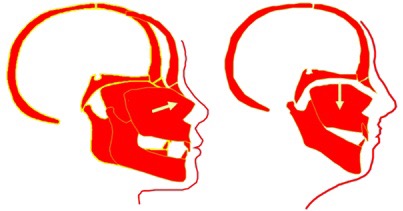
As we have already seen in the article on the “beauty bone” of the maxilla (anterior bone of the face, upper jaw), its position determines the correct position of the tongue on the palate. In short, it means that the tip of the tongue is in the recess behind the upper teeth, and the tongue itself is literally stuck to the palate from base to tip (with some nuances). Due to the force of pressure of this strongest muscle of the body on the maxilla from insude, it is pushed up and moved forward. In the articles mentioned above, we mainly talked about the effect of this process on the beauty of the face, now it’s time to figure out how the wrong position of the tongue affects health.
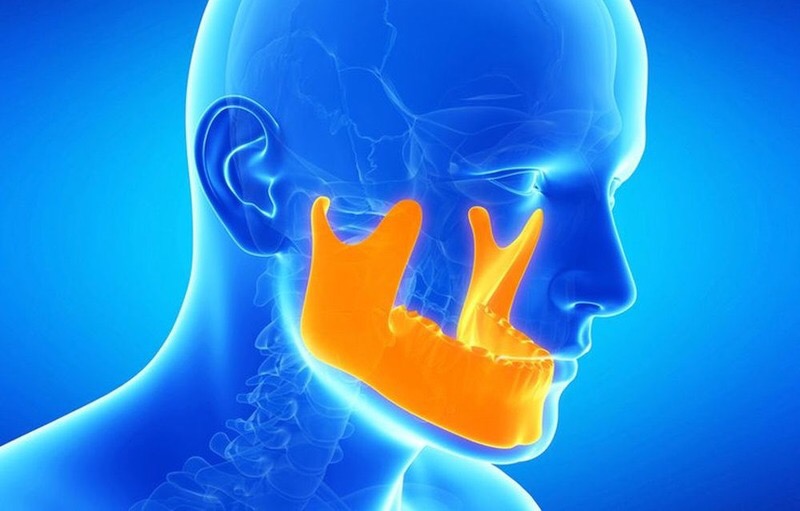
When the tongue is not at the top of the palate (at rest and swallowing), the maxillary facial bone drops down and back (we can see this in the picture above). Lowering it reduces support for the eyeballs, flattens the cheekbones, narrows the nasal airways, lengthens the middle of the face and narrows the palate, which in turn leads to malocclusion. In addition, due to the fact that the maxilla descends backward, it also blocks the lower jaw in the posterior position, forcing it to move backward. As a compensatory mechanism, the lower jaw forces the head to tilt forward and fixes it in this position, limiting the volume of the pharynx and thus the work of the airways.
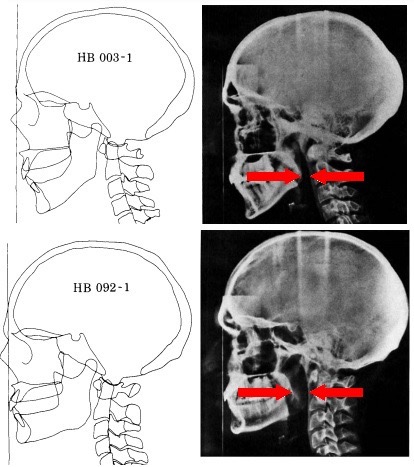
For example, in the images above, we see two patients, the first of whom has the so-called facial retrognathism – the posterior position of the upper and lower jaw. Note the forward, non-vertical position of his head and reduced airway space. The second patient has horizontal development of the upper jaw (maxilla), and the forward, normal position of the lower jaw. Its head is upright, aligned with the neck, and has ample airway space.
How snoring occurs
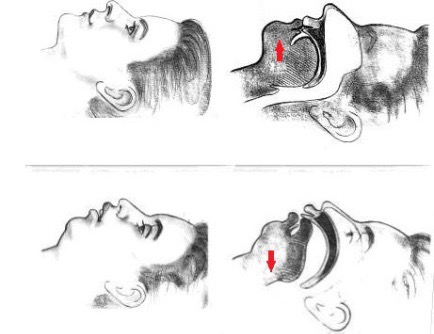
Shrinking of the upper airways, including narrowing of the nasal cavity, is a key element in the development of snoring and obstructive sleep apnea. In people with vertical growth of the maxilla (down and back), the palate narrows and falls, and therefore the tongue is located in a low position closer to the respiratory tract. When such a person goes to bed, his tongue and soft palate block the airway, which interferes with normal air flow.
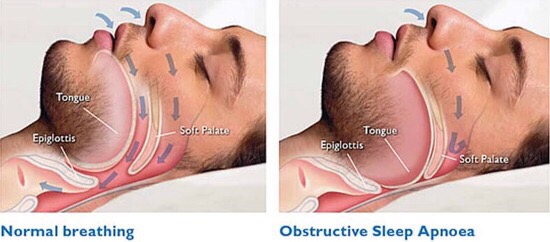
When obstruction (obstructio, lat. – hindrance, obstruction), and simply – blockage of the airways is only partial, the air still passes through the airways, causing only more resistance, which causes the noise typical of snoring. But in this case, it is usually continuous. This is how ordinary snoring differs from apnea – with the latter, the collapse of the walls of the airways at times blocks breathing completely, and a person who wakes up next to him during periodic cessation of breathing hears snoring, broken by pauses. At this time, it becomes more difficult for the diaphragm to work, and therefore sleep is temporarily interrupted (sometimes for a few seconds). This, in turn, activates the muscles in the throat that open the airways. At this time, the person nearby hears a deep breath, and the snoring starts breathing again. Some people with sleep apnea can stop breathing during their sleep for ten seconds or longer — dozens or even hundreds of times every night.
Dangers of snoring to health
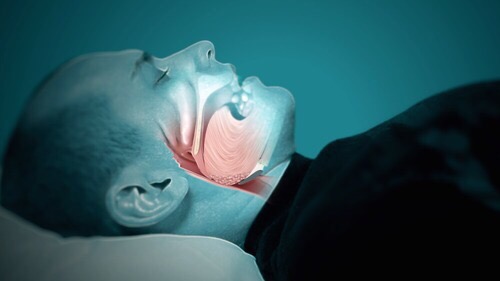
Here we will talk about the snoring that accompanies sleep apnea. Every time breathing stops, oxygen (O2) in the blood drops, and the carbon dioxide (CO2) content remains the same, which disrupts the normal physiological functioning of the cardiovascular system during sleep. Hypoxia (a deficiency in the amount of oxygen in the blood reaching the tissues) and hypercapnia (an increased level of carbon dioxide in the blood) stimulate the ventilatory effort, and, ultimately, awaken from sleep for a short time to resume breathing (although often a person thinks that he was awakened by sound snoring).
During respiratory arrest, blood pressure rises, which can reach 240/130 mm Hg, and remains elevated for some time after breathing resumes. At this time, the heart beats irregularly and may even pause its work for a few seconds. This is what causes deaths in people who go to bed in apparently good health. According to American and Japanese researchers, hypoxia caused by sleep apnea and poor sleep quality are also associated with a decrease in concentration and memory in humans. In turn, this is a risk factor for the development of dementia and Alzheimer’s disease later in life. Also, according to studies, due to changes in blood pressure, apnea is considered one of the reasons for the development of cardiovascular diseases and hypertension. Conventional medicine cannot explain these relationships, but individual researchers have already shown a clear link between snoring, sleep apnea, hypertension, cardiovascular disease, dementia, Alzheimer’s disease, strokes, and even sleep deaths.
In addition, improper development of the craniofacial system leads to the development of compensations in the body (lowering of the head, kyphosis, lordosis, scoliosis). To maintain balance, the muscle chains of the body are in this case in constant tension, which can cause compression of blood vessels, veins and arteries, followed by hypoxia, hypertension and even hair loss. Interestingly, some researchers have documented such a link between baldness, hypertension, and coronary heart disease. Now, seeing this big picture, we can understand how craniofacial development may be responsible for all of these unclear connections in conventional medicine.
Biomechanical treatment of snoring
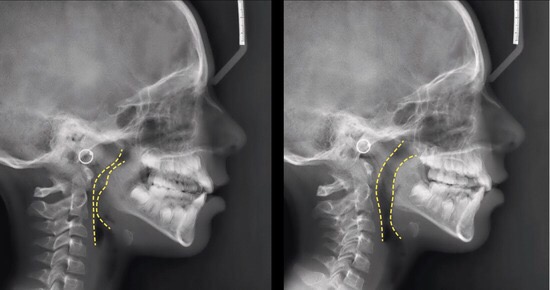
As you already understood, a real and complete cure for snoring is possible only by expanding the airways, which, in turn, is possible due to the movement of the lower and, most importantly, the upper jaw forward. This can be achieved in several ways. One of them is a high-end orthocraniodont, who works with the ALF device that expands and balances the upper jaw (be careful, because orthodontists who work only on braces, on the contrary, often narrow the maxillae, which pulls them down! You can read more about this – see how braces damage faces). An example of how ALF orthodontics affects airway health can be seen above. The second method is the implementation of myofunctional exercises (mewing), which, by training the position of the tongue, allow you to push the maxilla forward and upward. True, to achieve results in this case, it will take persistence and about a year of time.
Two other methods that are widely used today to treat snoring should also be mentioned here – their pros and cons. The first is CPAP-therapy, when air is blown into the patient’s respiratory tract through a mask using a special apparatus under a certain pressure, which creates an “air spacer” in the oropharynx. This “spacer” widens the patient’s airway and prevents the root of the tongue from sinking into the throat and obstructing the airway. Thus, the airway remains passable during inhalation and exhalation during sleep. Such masks do their job remarkably well and the next morning a person feels sleepy, his blood pressure normalizes and concentration improves, but the disadvantage of CPAP therapy is that sleeping in such a mask is not always comfortable all the time (you can see on the Internet what she is like represents), and the device to which it is connected is not always convenient to carry with you.
The second way is surgery. Currently, several methods of surgical interventions have been developed, the purpose of which is to expand the pharynx by removing the soft tissues of the pharynx in order to improve the patency of the patient’s airways during sleep. This method, with a favorable outcome in a significant number of cases, either completely eliminates snoring, or significantly reduces its manifestations. At the same time, complications are possible after such a surgical intervention – for example, inflammatory processes, intense pain requiring the use of pharmacological drugs, swelling of the palate and pharynx, which further increases snoring; more frequent episodes of sleep apnea under the influence of painkillers.
As you can see, the last two methods of treating snoring try to cope with the consequence of the problem, but in no way affect its cause – the wrong position of the upper and lower jaw leading to a decrease in the airways! In addition, these methods have their drawbacks and even side effects, which cannot be said about biomechanical therapies that not only relieve snoring, but also improve appearance and overall body position. Plus, myofunctional exercises are also free! It seems that the choice is obvious, but everyone makes the decision for himself.
7 comments
Ask a careful question or add useful context. New comments are reviewed before publication.