
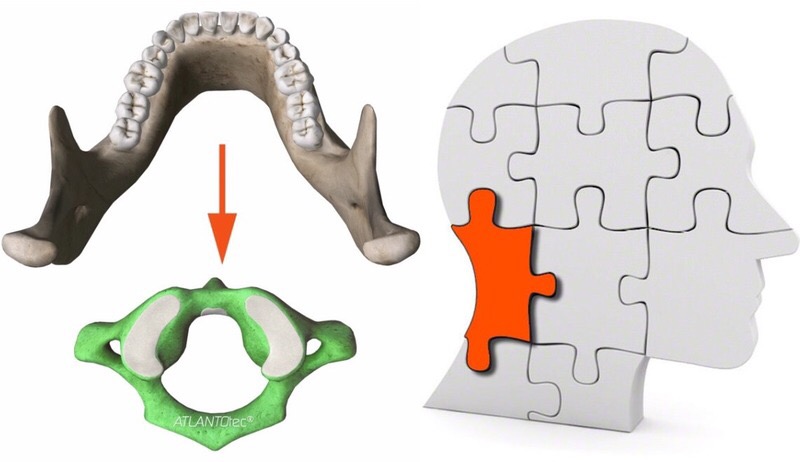
Even people far removed from medicine know very well about the negative consequences of displacement of the first cervical vertebra, the atlas: migraines, headaches, dizziness, pain in the neck, shoulders and back, and even mental disorders. Yet when consulting a manual therapist or bonesetter, many discover that manually repositioning the atlas sometimes brings only temporary relief, or even a significant deterioration in their condition. We will try to understand why this happens in this article.
Atlas displacement and dental occlusion
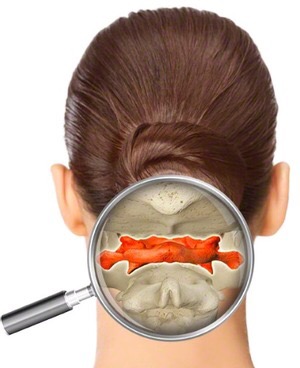
Scientists proved experimentally long ago that manual correction of the first cervical vertebra often has a positive effect on the position of the jaw, and a treated patient demonstrates a more symmetrical body position. However, in most cases, posture is corrected only partially after repositioning the atlas. Researchers have clinically proved that, in this situation, the patient's malocclusion and existing jaw displacements prevent the first cervical vertebra from being repositioned. This is why the atlas problems cannot be resolved in these cases: first, the position of the jaw must be changed, particularly the dental occlusion, which is responsible for displacement of the first cervical vertebra.
How to identify displacement of the jaw

It is very easy to identify how far the jaw is displaced. Simply take a photograph of your face in a relaxed state, with your mouth closed and teeth together, and examine it. As you can see in the photograph above, the corresponding lines show the position of the lower jaw relative to the skull. If the jaw is ideally positioned relative to the skull, the eye and lip lines (L and R in the photograph) will be parallel to each other, and the centre of the chin will lie strictly along the facial midline. A deviation from this ideal pattern means that the person's jaw is displaced because of incorrect dental occlusion. In this case, the correct atlas position can be achieved only by changing the occlusion. Other types of treatment, such as working on the jaw muscles, will produce only a temporary effect, and sometimes displacement of the temporomandibular joints and atlas!
How jaw displacement affects the neck muscles and atlas
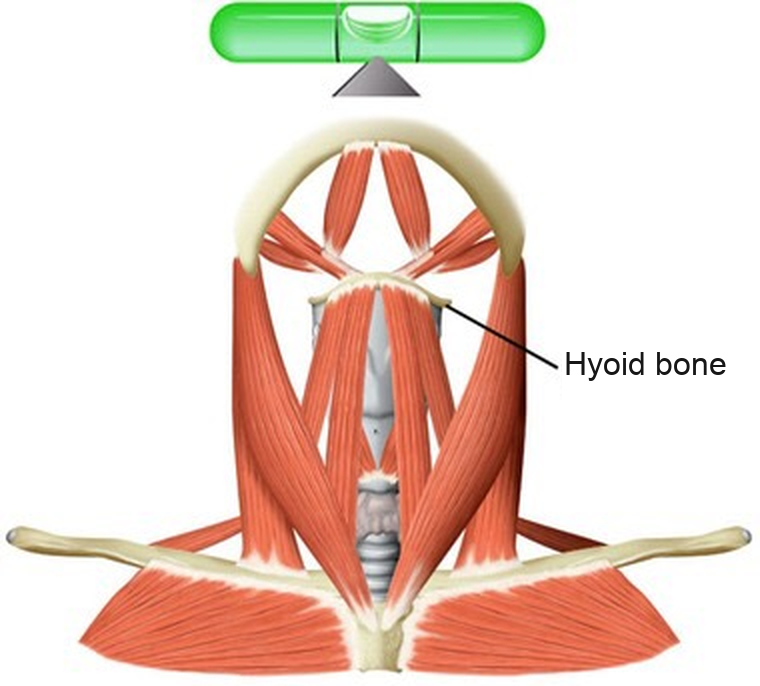
The lower jaw is connected to the back of the skull, cervical vertebrae and collarbones through a complex muscular system and the hyoid bone (Hyoideum), which literally 'hangs' 'by itself', because it is the only bone in the body not connected to other bones of the skeleton (which is precisely why it cannot be seen on three-dimensional models). The hyoid bone is connected to the jaw through muscles, and displacement of the latter inevitably leads to displacement of the hyoid bone. In this case, it acts on the muscle chains below it, connected to the collarbones and cervical spine, causing tension of varying intensity in them.
Through this mechanism, the hyoid bone regulates the body's static position, like a puppeteer controlling puppets with strings. Spasm of these neck muscles, especially the scalenes, leads to compression of the nerves and arteries beneath them. The inevitable change in muscle length on the two sides in this situation leads to cervical scoliosis. Moreover, lengthening of the muscles at the front of the neck leads to shortening of their antagonists at the back, and directly of the muscles connecting the skull to the first cervical vertebra—the atlas—which leads to its displacement.

So, as we can see, dental occlusion determines the position of the jaw; the jaw determines the position of the hyoid bone, which in turn regulates body position through the neck muscles, which also directly influence the first cervical vertebra, the atlas. Therefore, the slightest changes in occlusion—whether incorrect tooth positions from birth, extraction, fillings that are too high or too low, poor orthodontic work or prosthetic treatment—lead to displacement of the atlas, which for this very reason cannot be repositioned through manual intervention. Before performing this manipulation, it is therefore extremely important to examine the patient's dental occlusion and refer them to a competent orthocraniodontist, who will help not only to correct the malocclusion, but also to eliminate distortions of the skull structures. Without this condition, there is a significant risk of worsening the patient's already difficult situation, as well as wasting their money.
Atlas: consequences of displacement and myths about correction—here.
Scoliosis and osteochondrosis: their relationship and treatment using the biomechanical method—here.
__________________
Materials and photographs from https://atlantomed.eu/en/ were used in this article.


24 comments
Ask a careful question or add useful context. New comments are reviewed before publication.
As you noticed, I’m a fan of the work of the Italian posturologist and craniodontist Stefanelli. He writes a lot about this connection in his books, harmonizing the position of the atlas and pelvis in patients in exactly this way.
What do you think, would it make sense to buy Starecta first, since the price is more affordable and it seems to me the result will either be visible or not within the next few days/months. Then go to a dentist-orthodontist later, because the amounts they quote there are very high.
I’ll answer your question here. If that’s not enough, we can continue here, okay?
As for Starecta or ALF, it all depends on whether you have more “head” complaints with facial pain, or skeletal structural distortions. Starecta helps very well in the second case, but it does not eliminate facial pain. They officially warn about this themselves, and the device also does not correct cranial torsion. ALF orthodontics, in that sense, works as a full-package solution, so to speak.
But here’s the thing: the suffering and difficult condition do not stop immediately with ALF orthodontics, because absolutely all symptoms will be experienced in reverse order, and this can last up to a year and a half or two years. I’ve just interviewed a doctor about this, and I’ll publish it in the next few days. He talks about it there too. I’m on ALF myself right now, so I know what I’m talking about. And Starecta can also be used during this period, when it becomes completely unbearable and you just want at least a little break.
The Starecta splint literally relieves symptoms within hours. Because of the specifics of their method, the skull seems to immediately gain support from the lower jaw, literally as if it were standing on “legs.” I was just messaging with one of our guys; he has been on Starecta for a month now. He says he suffered a lot with an orthocraniodontist (though he isn’t sure the doctor was a good one), but with the Starecta splint most of his symptoms went away. I actually want to ask his permission to publish his review here on the blog, because a lot of people are interested.
So you can try Starecta right away and see how it feels. It is relatively inexpensive and gives relief quickly. It supports the TMJs very well, and maybe nothing else will be needed.
If you still have any questions, I’ll answer them all.
Please reply here
It’s easier to communicate that way)
Atlas – first cervical vertebra: consequences of displacement and myths about its fixing
More than a hundred clinical studies on this topic have been conducted worldwide.
So, if a person has not had obvious head or neck injuries, then as a rule it happens like this:
as a result of non-physiological childbirth (lying down, not sitting), the baby’s cranial bones become deformed: displacement of the temporal bones, all the internal bones, the occipital bone, and the facial bones (the upper jaw, the maxilla; hence the development of an incorrect bite).
Up to a certain point, all of this is compensated for perfectly, because, as our wonderful Dr. the practitioner, who studied this problem, says, “the body has enormous adaptive potential, and nature can be forced for quite a long time.”
Under the influence of stress and physical exertion over the years, this potential begins to decrease, until finally severe stress, with its muscle contractions, knocks the cranio-jaw system out of its fragile balance.
(I discussed this in more detail in the article on why dystonia symptoms appear after stress:
Why VVD symptoms appear after stress)
This is how the atlas shifts too, although the original problem lies in an unidentified deformation of the patient’s skull, which they received as a result of birth trauma. By the way, one Canadian researcher (I can’t remember the name off the top of my head right now) studied this problem and found cranial deformities in 95% of 1,200 infants! All because women are forced to give birth in a non-physiological position.
The good thing is that science does not stand still, and all these deformities can be corrected very well by an osteopath working together with an orthocraniodontist who uses an intraoral ALF appliance. So there is hope. The main thing is to find a competent specialist.
The thing is that the jaw is connected to the occipital bone through a complex system of muscles, and the atlas always adapts to its position. Rough interference in this compensatory mechanism without correcting the jaw position can lead to the most unpredictable consequences, as happened in my case, for example.
So, in my opinion, the first step should be to balance the position of the jaws.
Possible methods are described in full detail at the link:
You can find related materials in this archive.
You can choose a method for yourself at this link:
You can find related materials in this archive.
Self-treatment is possible using the Starecta method. Or you can consult orthocraniodontic specialists:
Craniodontics: the best specialists
There is also the occlusion-structure balance method:
Dental occlusion and body balance treatment method (available later)
We are looking for specialists in this field, and the list should appear sometime this month.
Can I ask you some questions in private messages?
You can also read related discussions in this archive. There is also a discussion section here where you can ask technical questions: this archive
Can you trust your dentist? (available later)
He talks about bruxism there, but hypertonicity of the chewing muscles is essentially their asymmetrical work, which causes them to become overstrained. The cause is a problem with occlusal height on one side or in the back part of the jaw.
the images you posted were copied from the website atlantomed.eu. Please add an ACTIVE link to https://atlantomed.eu An active link is a condition for using the images. thank you and good work.
Giuseppe Stefanelli has died