

Ready for the shocking truth about braces and conventional orthodontics? Braces are disastrous for the contours of your face. World-renowned doctors in orthodontic treatment, such as Eric Gibbs (USA) and John and Mike Mew (UK), have been researching this problem for decades, lecturing on it and writing about it in medical journals. Nevertheless, millions of people around the world today undergo orthodontic 'treatment' with braces that literally steal their beauty. We will explore why this happens in this article.
'Little old ladies' faces' as the result
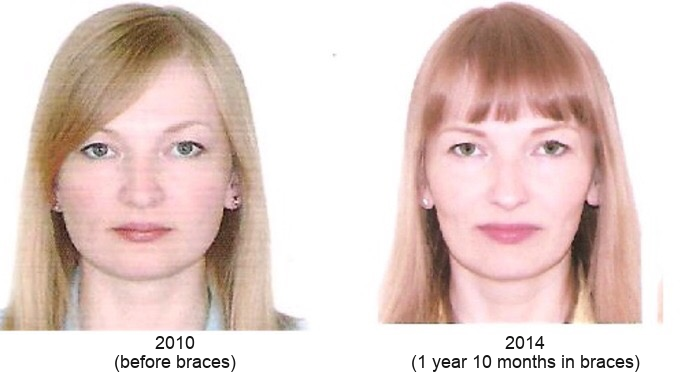
The orthodontic world does not want to acknowledge that using braces harms people's faces, despite seeing evidence of this work right in front of it every day. These 'specialists' ultimately advise people shocked by changes in their faces after braces to see a psychotherapist. Yet nobody warned them about such changes before the orthodontic intervention. As the well-known Russian TMJ-treatment doctor A. O. Savinov says, 'If a patient is told about all the problems before treatment, it is a diagnosis; if afterwards, it is already an excuse.'
I myself suffered from orthodontic treatment that harmed not only my appearance and self-esteem, but also my health. Still, women worry about their appearance first and foremost. In the opening photograph for this article, we see an amazingly beautiful young woman whose face literally became drawn after braces. As she herself describes on http://breket.info, every acquaintance she meets asks what has happened to her and whether she is ill. This patient's face is still beautiful, but we cannot help noticing that her facial contours have lost their prettiness and she seems to have aged. In a discussion on one forum, the legendary A. O. Savinov put it very precisely: in many cases, after braces, young female patients with lovely cheeks end up with 'little old ladies' faces'. Dr Gibbs from the USA collected information about such cases for forty (!) years; it became his life's work. All his research points to what is already clear as day: braces lengthen the face by encouraging its vertical growth. Meanwhile, it is now a generally accepted fact that the long-term success of orthodontic treatment depends on the direction of facial growth, and that so-called forward-growing (horizontally developed) faces look better.
A big difference


In the photographs of the two young women above, we see a huge difference in the position of their upper jaw—the so-called maxilla—and how it affects facial beauty. The woman on the left has an upper jaw that projects forwards, while that of the woman on the right extends downwards. According to the famous founder of orthotropics (horizontal facial growth), Dr John Mew, the reason for this difference lies not in genetics but in adverse environmental influences that distort the pattern of facial growth: no or insufficient breastfeeding, resulting in inadequate development of facial structures; birth trauma; thumb or dummy sucking; insufficient hard food; and poor orthodontic treatment. The woman on the left grew up in conditions favourable to facial development, while the patient on the right was less fortunate and, moreover, underwent treatment with braces. The number of people undergoing this unfavourable vertical facial growth is steadily increasing.

Animators know very well that, to depict an attractive face, the upper jaw must be positioned horizontally and brought forwards. In the drawings above, you can see that the cheekbone line of the 'attractive beauty' runs parallel to her nose, while the maxillae of the 'evil face' are set back and extend downwards. The direction of upper-jaw growth is also extremely important for tooth development. For example, in 1983 the Norwegian doctor Zachrisson reported less dental crowding with horizontal growth of the upper jaw, while Woodside (1996) found that this also applies to the lower-jaw canines, which are forced to crowd when blocked by a vertically positioned upper jaw and a lengthened face.

Intraoral devices for horizontal facial growth began to be developed in Europe and America as early as the beginning of the twentieth century. They developed particularly in the eighties and nineties, when the best-known intraoral upper-jaw expansion appliances of today, Bioblock and ALF, appeared. This research turns all the ideas taught to dentists and orthodontists today upside down, but for some reason does not become widespread, although the advantages of the method are more than obvious. The most telling case in this regard is the story of two twins, whose photograph is shown above. Before orthodontic treatment they looked almost identical, but the first underwent braces treatment with extraction of crowded teeth, while the second was treated with a jaw-expanding intraoral appliance without tooth extraction (using the orthotropics method). Orthotropics brought the upper jaw forwards, while conventional orthodontics moved it backwards and extended it downwards. Look once again at the cheekbone and chin lines relative to the nose!
Why braces lengthen the face
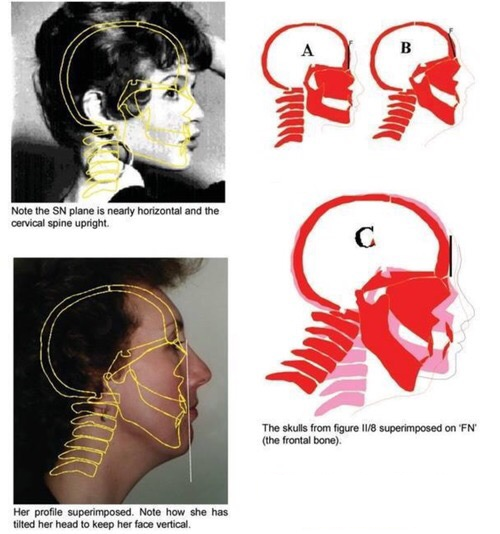
Try Googling photographs of models' faces in profile, and you will see that all these beautiful people have an upper jaw that projects horizontally forwards. Braces, by contrast, cause the maxillae to extend vertically. Many factors contribute to this, but in simple terms the problem looks like this: the braces' archwire acts evenly on all the teeth at once. Which teeth will win this 'tug of war'? The large molars with their more developed roots. This is precisely why braces pull the facial bones backwards and narrow the dental arches. The teeth do indeed become straight, but, alas, the smile becomes narrow and far from dazzling—not the one we had hoped for. The middle of the face becomes longer and flatter, and facial development proceeds in quite a different direction from that of models…
But that is not all. When the upper jaw moves backwards, it inevitably affects the throat and forces a 'compromise' with the airways, resulting in snoring. The only possible real remedy for snoring is to expand the upper jaw and bring it forwards to create adequate space for the tongue. So, if you intend to treat crowded teeth with conventional braces, know that crowding is treated precisely by expanding the dental arches. The photograph below shows a young woman with unerupted upper canines because there was insufficient room for them in the dental arch. She was waiting for surgery to resolve this problem. Seeing orthotropics practitioners and expanding the upper arches with a Bioblock created the necessary space for the canines in a short time. Most interestingly, the girl's father, himself a dentist, had no idea that this method could solve the problem! And notice how much more defined the girl's cheekbones and face as a whole became after upper-jaw expansion.

What now?
In trying to straighten teeth, orthodontists literally ruin the patient's facial contours, because the sole aim of such treatment is to straighten teeth. Focusing only on this is rather ignorant, since patients value facial beauty more than straight teeth. Unfortunately, most patients wearing braces do not understand the destructive consequences such 'treatment' has for their appearance until it is too late. Skeletal dystrophy does indeed develop very slowly.
Orthotropics practitioners differ from conventional orthodontists in that they straighten teeth specifically by expanding the dental arches (using the Bioblock appliance). By addressing the main 'dental' problem, they encourage horizontal facial development, improving the face after treatment. The only problem is that this method is available mainly to children aged 8–12. But all is not lost for adults who underwent conventional braces treatment and discovered that their face had been ruined, or for adults who want to straighten their teeth and achieve greater facial harmony. In adults, these goals can be achieved through mewing (provided you have not had teeth extracted for braces with the spaces closed by the braces; below you see one such example in which additional osteopathic finger techniques were used):

Here is the accompanying feedback:

The patient describes changes over three weeks: “The photo on the left was taken immediately after I had to have my braces removed. Seven months of suffering, insomnia, pain in my neck and head, and a clicking TMJ. My condition is now improving, the headaches are much less severe, and I can see facial symmetry returning.”
Another alternative is treatment with an ALF appliance. Internationally, this ALF orthodontics is called craniodontics, while in our country it is known as orthocraniodontics. It is important to know that this treatment is a fairly drastic restructuring of all the structures not only of the face, but also of the skull and the whole posture. Not everyone can withstand such treatment psychologically and physically, and here I write frankly about all the possible 'pitfalls' of such a very deep intervention. Moreover, there are, alas, very few top-class specialists in this field in our country, but I hope this offers at least some hope to those whose faces have been damaged by ignorant orthodontists. If you have thoughts on this, or would like to share your story, please write about it in the comments!
The maxilla: the bone of beauty, or everything about the upper jaw—here.
The consequences of braces: what nobody warned you about—here.
_______________
Materials from claimingpower.com and forum.stom.ru were used in preparing this article. The opening photograph was taken from http://breket.info.


149 comments
Ask a careful question or add useful context. New comments are reviewed before publication.
I have been wearing braces for six months, noticed changes in my appearance, and found your story. I want to have them removed and restore my skull. I am looking for a specialist.
a necessary condition for getting rid of crowding. Dentistry develops just like every other branch of medicine. You know that people once used radioactive face powder and drank pearls dissolved in vinegar, right? I think you do.
Only later did people start noticing the elongated faces of Americans after premolars were removed en masse in the 1970s and 1980s during adolescence. What, do you really think born butchers go into dentistry?
Maxilla – the bone of beauty, or all about our upper jaw
It is the maxilla, when moved forward and upward, that makes the face three-dimensional, which is very attractive, as you can see from the many photos in the article.
With the short mandible you mentioned, the upper jaw, the maxilla, is also set back in many people, creating what is known as a flat face. In such cases, moving the maxilla forward and expanding it, meaning the midface, paradoxically improves the position of the mandible and the overall aesthetics. You can see this for yourself, for example, by looking at this image: https://ibb.co/gggRBy
(the woman’s upper jaw was brought forward with an ALF appliance; compare the position of the mandible before and after treatment)
Any vertical “alignment,” meaning moving the maxilla downward, reduces support for the eyeballs, which makes the eyes look sunken, and also blocks the mandible from moving forward. So the benefit for facial beauty here is very questionable.
In addition, any retrusion of the mandible that accompanies a maxilla pushed backward and pulled downward inevitably leads to changes in the cervical spine, sometimes with catastrophic health consequences. You can see this for yourself by Googling what happens to many people’s health after braces.
Sunken eyes, hollow cheeks, and cervical spine problems?
Can this somehow be reversed?
“not all is lost for adults who have gone through traditional braces treatment and discovered that their face was damaged, or for adults who want to straighten their teeth and achieve greater facial harmony. In adults, these goals are achieved with treatment using an ALF appliance. In international practice, this kind of ALF orthodontics is called craniodontics, and in our country it is known as orthocraniodontics.”
What ALF orthodontics is:
ALF orthodontics: what it is
Have you managed to resolve your own problems? (You write in the article that you suffered as well.)
Dystonia as biomechanical trauma: my experience
As one possible option for addressing the problem, you may be interested in myofunctional correction using the orthotropics method mentioned above. It raises the maxilla with good results:
Proper tongue posture, or how to stop the face from ‘drooping’
I have been wearing braces for six months, noticed unpleasant changes, and want to have them removed.
I found your comment.
Wisdom Teeth: To Pull Or Not To Pull? (available later)
You can also review related notes in this archive:
You can find related materials in this archive.
I hope this information helps you decide.
I have been wearing braces for six months and I can already see changes for the worse.
What kind of doctor should I go to in order to fix everything?
It is 2024 now, so maybe there is a specific doctor who has proven themselves and has good reviews. several large clinics.
Thank you in advance.
I am extremely concerned about this question: is the extraction of healthy teeth in orthodontics considered proper treatment, and how does removing such teeth affect the body? Among people I know who wore braces in the past, the 4th and/or 8th teeth were often removed to create space in the dental arch.
I am about to start treatment, so I would like to learn as much as possible about this issue.
Or perhaps you have links to sources for this information? Please share them. Thank you!
Mike Mew also has a public lecture archive — search for orthotropics, everything is shown there very clearly.
The second source is the research of American doctor Eric Gibbs. He has been working on this problem for more than forty years — https://www.gibbsortho.com/common-orthodontic-issues But also google him to find all of his materials.
As for removing premolars and wisdom teeth, Natalie, that question is not really appropriate for me. I am not a doctor, I am a patient.
In traditional orthodontics, as far as I understand, it is considered acceptable, but scientific research on how their removal affects the body is not being done. The exception is a handful of doctors who have devoted their lives to this issue (two of them are mentioned above), even though they do not fit into the mainstream.
As for my own experience with wisdom tooth removal: my husband had all of his removed as a teenager, and nothing happened to him at all. But after I had just one removed, my life was split into before and after. According to the belief of another patient who suffered in the same way, a Spanish man, when wisdom teeth are removed, a cubic centimeter of bone tissue that supports the skull is removed along with them.
With premolars, it is probably the same story — some people will be fine, and others will not. For example, this summer a girl wrote to me who had two premolars removed, and it was a terrible case of TMJ dysfunction with disc repositioning, disabled at 23, even though she had already spent the price of an apartment on treatment. The situation only started to change now, when she found a competent orthocraniodontist.
In my opinion, you need to look specifically at patient reviews about how they felt after wisdom teeth and premolars were removed for braces — there are a lot of them online!
I believe a decision like this can only be made after studying the problem from all sides. And the final decision is yours alone.
Could you please tell me how to get my bite back to the way it was? Or could it go back on its own, since I wore braces for such a short time?
Thank you for your reply!
ALF orthodontics: what it is
Orthocraniodontists treat these kinds of problems. In many places this field is still only developing, but there are already good specialists. They mostly deal with temporomandibular joint dysfunctions, when a person is already feeling quite unwell. But of course, they also help restore facial balance, because together with a craniosacral osteopath they restore the cranial structure. This list may help you get oriented with specialists:
Craniodontics: the best specialists
For cases after braces, I would keep the focus on careful diagnostics.
I found your blog two weeks after getting my braces off. Just my luck. )
I have been doing mewing for a couple of months now, and there are tiny changes. I can see that the teeth without retainers are moving, and specifically outward: the jaw is widening.
I am studying The Great Work discussion thread and Esther Gokhale's book on posture.
Better late than never. )
Thank you so much for popularizing this information in local. )))
It is great that there is a place to share your story. And to have the right to be unhappy with the orthodontist's work. )
On The Great Work, they believe it is better not to remove retainers until you are completely sure that the tongue has adapted to the new posture. And one man expanded his palate even with them — by 4 mm. Which is an amazing result in itself. These are the miracles of proper tongue posture. ))
Very few orthodontists give patients that right, and often the orthodontist does not even know what they are doing to the facial form. Unfortunately, many people go on living with a damaged appearance after the humiliation of being completely misunderstood and being advised to see a psychologist. We need to share stories like this.
And for these exercises, thanks to Mike Mew. On The Great Work you have probably noticed the photoshops of him with a halo over his head and captions like: "I pray to Mike Mew every day" ))) A great man.
Thank you so much for your support. In a situation like this, it is very important to look for a way out and to understand that the problem is not your perception.
Great — absolutely. The petition in support of official medicine studying his methods already has more than 9,000 signatures. 🙂
You can see a list of them locally and my area here:
Craniodontics: the best specialists
We also already have specialists who work with the orthotropics method, but you have to look for them.
Yes, ALF fully restores the natural shape of the face:
A non-surgical facelift with ALF: an ordinary miracle
Look here at the list of specialists abroad. Maybe you will find someone in your country:
Craniodontics: the best specialists
There are also mewing exercises by the British doctor Mike Mew, which lift and expand the maxilla well. Materials on this topic:
Proper tongue posture, or how to stop the face from “collapsing”
Proper tongue posture, or how to stop the face from ‘drooping’
Mewing exercises: how to “mew” correctly
Mewing exercises: how to ‘mew’ correctly (available later)
At the link you can see the possibilities of orthotropics, orthocraniodontics, and the occlusal-structural balance method, as well as the intraoral devices used in these methods:
You can find related materials in this archive.
But there are exercises such as mewing. They expand the upper jaw and create more space for the dental arches, and there is a good chance of changing the position of the teeth, restoring a beautiful facial oval, and even improving it by bringing the midface forward, getting high cheekbones, and even fuller lips. Here is what you can read about this:
Proper tongue posture, or how to stop the face from ‘drooping’
Mewing exercises: how to ‘mew’ correctly (available later)
The second article describes it using boys as an example, but the results of mewing in girls are interesting too (I’ll write about that sometime as well). At the beginning of the article there is a link to a public lecture archive with materials on mewing translated into local. I sincerely hope this information helps you.
There really is a good specialist in Rostov. People write me a lot of good reviews about him.
There they will put all the teeth in place and restore the normal shape of the face.
As for how much the treatment will cost, the prices vary depending on the case. Definitely not less than 2,000 euros.
A clarification about orthocraniodontics, Starecta and other devices (available later)
At the final stage, braces are then added.
The algorithm for this kind of treatment is described here:
Orthocraniodontics: philosophy and the basic treatment algorithm
I hope this information helps you understand your situation and decide what to do.
As for the name, everyone understands perfectly well why the blog is called that, but in English it does not look quite as provocative ) But thank you for the tip, I will think about it )
From the article, I did not quite understand exactly how braces lower the maxillae. Is this only in cases where the teeth were flared out like a fan?
All orthodontists say in unison that the jaw needs to be expanded, and they do this by changing the inclination of the teeth outward. And self-ligating systems are supposedly designed by the manufacturer for jaw expansion.
Is there somewhere I can read in more detail about exactly which processes during braces treatment lead to narrowing? What vectors act on the teeth, does this apply to all cases and all systems, or is it simply mistakes by orthodontists who think a narrowed jaw looks more beautiful?
The archwire of a braces system is always anchored to the molars, which have much stronger roots than the front teeth, so in many cases the tooth inclination is corrected, while the maxillae are pulled backward and downward.
This is if we are discussing the purely aesthetic side, although braces systems completely ignore the vertical height of the teeth, which is needed to support the joints, and this leads to major health problems. You can read about this, for example, in an interview with an American TMJ treatment specialist:
Jeffrey Brown (USA): “Dr. Good” (interview) (available later)
(the middle part of the interview).
And information purely about aesthetics can be found in the articles by Mike Mew and Eric Gibbs, which I linked to at the beginning of the article. They studied this problem specifically.
The harm can be minimized if you understand exactly how braces and the orthodontist work. I recently learned about a case where the upper jaw and lower jaw were pulled together with elastics, while the lower jaw was already narrower. As a result, the lower jaw expanded, but the upper jaw narrowed and pulled the maxillae along with it! I am very glad I found out about this; now I will not let the orthodontist expand the lower jaw at the expense of the upper one. There are other methods, for example springs, which act only on the lower jaw.
The orthodontist does not take this into account, but I think it will be possible to ask and monitor things so that they do not do “harmful” actions.
I also assume that people who have spaces or diastemas closed also have their upper jaw narrowed, simply because the dental arch is being pulled together around the circumference. In that case, perhaps you can stop braces at any stage without consequences, and for aesthetics it would be better to choose veneers or restoration.
For those who are currently wearing braces, it would be very useful to know examples like this so they can make further decisions about treatment: either give up braces, or monitor the orthodontist and force them to look for safer options for moving the teeth.
(the clinic's archive notes this archive )
Thank you!
The Consequences of Braces: What Nobody Warned You About
(this is in the discussion section here)
Everyone describes the situation with a narrow upper jaw, but what if the jaw is wide and the teeth have gaps between them, with a large diastema? Would braces be harmful in that case too? I would really like, if not to close it completely, then at least to make the diastema smaller... but I really do not want my face to age!
The basis of her treatment
A mouthguard! I sleep in it every day and expand the dental arch. I get checked often, and she doesn’t even charge a single ruble for regular check-up visits, which is unthinkable for several large clinics.
The result
I’ve been in treatment for a year now. I’m 25 now, and I feel like I look younger than I did at 20. My boyfriend agrees)) (he’s actually the one who found this doctor, by chance). Now our whole family goes to her.
My face has become more model-like over the year. Some! teeth have even already moved into place. Not even close to all of them yet. This kind of treatment takes a lot of time and patience, depending on how difficult the case is. But I like everything! The main thing is that all my teeth stay with me, and I can see a result that I like.
the doctor’s general information
Bondareva Maya Valentinovna. a private contact
several large clinics
You can also google her. You’ll find a lot of different information.
Of course, let the the doctor’s general information stay here. They may be useful to others.
An important addition: I’ve been doing facial muscle exercises for 6 years already. And my before-and-after photos are roughly like those of women who do mewing. My cheekbones have lifted noticeably, my facial oval has become defined, and my maxilla has lifted a little. Maybe the exercises affected the deep muscles to some extent too, which is why the changes happened. I also got used to the braces easily, with no pain or damage to the mucosa. I think that’s also thanks to the fact that I work on my facial muscles.
Could you tell me what happens if you do mewing with braces? Plus train the facial muscles every day? Maybe in my situation the braces won’t pull my jaw down? And the time I need to wear them should be shorter with all of this too? You won’t believe it, but in these 8 days my protruding front tooth has noticeably moved backward)))
this archive
Maybe everything will be fine for you in that sense. If not, there are specialists who understand cranial biomechanics.
As for mewing with braces, you can refer to this article:
Mewing and Retainers (available later)
Take a look at this article on how hollow cheeks develop with mewing:
Hollow cheeks: how they develop with mewing (available later)
In short, it happens through 3D facial development and the formation of a convex “triangle of youth.” At the same time, for many people with round faces, as the maxillae move forward and lift, the lower part of the face becomes slimmer. In any case, the face takes on the shape it is naturally supposed to have. You can also look at mewing results in women on this topic:
Women's mewing results (available later)
For many people who had a “square” face, it becomes narrower, and conversely, for some it becomes rounder. With a certain amount of effort, appearance can be changed!
I’ve been putting off getting braces for about 3 years now. Maybe not for nothing, although there are indications for them: crowded teeth, and the left canine is practically sitting on top of the others. To be honest, the situation with my teeth is pretty bad: most of them have fillings, some lower chewing teeth are missing, and an upper fifth tooth is missing too. I saw an orthodontist because I had a joint problem: when I opened my mouth there was terrible crunching and clicking. They made me an occlusal splint, I wore it at night for about 6 months, and the crunching and clicking went away. The orthodontist said I could get braces, but before that I would need to have all my wisdom teeth removed (I’ve already had 2 removed) and the left sixth tooth as well, because the tooth is “really bad,” so the canine could move into its place. I am absolutely not ready to have that many teeth removed. At the same time, I can see that my face has become a little asymmetrical and my upper lip has gotten smaller. So I definitely need to do something, but I still don’t understand where to start or how to continue. Maybe I should go for a consultation with some specialist, maybe not even an orthodontist? Should I get some scans done? And where should I go with them?
I would be very grateful for your opinion/advice.
Judging by your description, you definitely need to see not just a regular orthodontist, but specifically a specialist who understands cranial biomechanics. These doctors may call themselves craniodontists, orthodontists and osteopaths, or specialists in functional orthodontics who work with the ALF appliance. We have a list of such specialists here:
Craniodontics: the best specialists
There are also already some reviews in the discussion section here:
You can find related materials in this archive.
You don’t need to get scans in advance, because first of all, they can be difficult to get without a referral, and secondly, the specialist may need certain scans in addition to the standard ones. Then you would have to go and have them done again or redone, so there’s no point spending extra money.
The main thing is to find a good, competent specialist.
Take another look at the list of specialists in nearby cities, maybe you’ll find someone:
Craniodontics: the best specialists
And we’re trying to collect reviews in the discussion section here:
You can find related materials in this archive.
http://www.breket.info/blogs/1073907065?page=1
http://www.breket.info/images/image1073907064
The author writes:
“Now yes, about 3 kg less than my usual weight”
So what is this whole article even worth? The girl simply lost weight. Funny, honestly.
But it’ll do for advertising your quacks. Someone with experience being treated by a clumsy orthodontist probably won’t dig too deeply into the information.
And once your emotions and righteous anger over imaginary exposés and attempts to provoke us calm down, you’re welcome to join our reader discussion area and admire the faces of our members that were disfigured by braces. You do like digging deep, after all.
You can find related materials in this archive.
I’m 17. My teeth are a bit crooked because my jaw is narrow. Do I understand correctly that mewing expands the upper jaw? Can this expansion affect the position of the teeth, meaning could they straighten out even a little?
You can find related materials in this archive.
The photos shown above are of completely different people. With completely different ears.
Stop misleading people!
But unfortunately, the phrase you copied literally says the following: “in the photos shown above of TWO girls” (not one), so it really is about TWO different girls.
I’m glad you were able to let off steam here and feel better.
All the best to you!
I hope this helps you figure out your question.
But the issue here is not the tools the specialist uses, but the specialist’s own level of knowledge. If they understand the biomechanics of the skull, then sometimes they may even use braces right away as well; it all depends on the specific case.
Traditional orthodontists, however, usually work only at the level of the teeth, without taking into account the position of the facial bones and the position of the temporomandibular joints, which can lead not only to a loss of attractiveness but also to health problems; it is like local roulette, 50/50. That is the problem, not the beautiful smile.
Sorry, I just no longer have the energy to duplicate this information many times.
So, the orthodontist prescribed the classic route: removal of the wisdom teeth (they had all erupted, but they really were getting in the way), then gum surgery (vestibuloplasty and cutting the upper lip frenulum). Clear ligature braces were installed. After a few months the first problem appeared: gum “black triangles.” The doctor said to inject hyaluronic acid into the gums. The periodontist said they should be closed surgically. In the middle of treatment they had to grind down the spaces between the lower incisors, which led to cracks and chips and increased sensitivity. After about a year of treatment the teeth were relatively straight, the overjet had been closed by changing the angle of the upper and lower incisors, but I kept complaining about tension and not being able to close my lips. The doctor said nothing could be done, it was muscle hypertonicity, and I would need Botox injections. I refused, because a cosmetologist said the effect lasts only a couple of months, and then there is atrophy! The second mistake was removing the 5th tooth in the upper jaw. Because I was complaining, the orthodontist decided to push the upper teeth back even more and make space for that. After that everything went really badly: the incisors, canines and premolars were pushed back too far, overcorrection began (the upper teeth were hitting the lower ones), so the 6th and 7th teeth (the second and first molars) started moving forward to close the space left after removing the 5th teeth, and in the end they settled incorrectly. There is no tight contact with the lower teeth, everything got worse, the dental arch narrowed even more, my tongue has tooth marks on it, the occlusion was disrupted, I started chewing food badly, the tension got worse and moved into deeper facial muscles, closer to the ears and across the whole jaw. The lower second molars started rotating. The midline shift increased (although we had been fighting it with elastics for many months). And after about 1.5 years of treatment my face became gaunt, hollows appeared, actual pits in my cheeks, because there are no teeth in the place where the cheek rests on the teeth. Those very dimples that social media models dream about. My face changed very strongly; people say it became like an old woman’s face. All my acquaintances, relatives, and my husband started noticing it, saying I looked like death. I was overwhelmed with horror! I cried into my pillow! I went to consultations with everyone I could find (everyone basically brushed me off). At every appointment/activation I told her about all of this, about all the problems that worried me, and asked her to refer me to other specialists for broader diagnostics. The orthodontist laughed and said I was imagining it, that I had just lost weight, that it had always been like that, that she didn’t notice anything, and that the facial changes had nothing to do with braces. In the end I recently changed orthodontists and went to the chief doctor. She sent me to a proper maxillofacial surgeon, he did the diagnostics, and then I heard from him all the same words that I had been saying to the orthodontist. As a result, I need bilateral osteotomy of both jaws, and before the surgery I need tongue surgery, then visits to an osteopath every month, then splint therapy for at least six months, restoration of the unnecessarily removed teeth, and then under the knife... In short, I’m completely stuck! Especially financially (osteotomy costs 300 thousand rubles here). I lost so much time and money, so many nerves, and my face, which was literally broken!! My self-esteem has worsened, I stopped taking photos, I worry constantly. And nobody in my city has even heard of an ALF appliance or Biobloc! This kind of treatment is not done here. And this is the third-largest city by population! No alternative at all... After your website, everything fell into place in my head. To everyone who is getting braces, I advise you to think 100 times first! Thank you for listening...
You can find related materials in this archive.
Mewing may not fully straighten the bite, but there is a chance it can improve it significantly. For example, you can see this by looking at before-and-after mewing photos in this thread in the discussion section here:
You can find related materials in this archive.
You can find related materials in this archive.
I’d also like to add some interesting information from my own experience, and I know it’s true. Under no circumstances should you lower the height of the side bite, I mean the area where the molars are, up to the canines. I have something similar to an open bite, although there isn’t actually a gap between the upper and lower teeth, but still, the upper teeth are much shorter than all the others. So many orthodontists want to correct this so-called open bite for me by lowering the side bite. But the thing is, when the molars wear down with age by even half a millimeter and the bite drops a little, the facial oval starts to sag and nasolabial folds appear. So, dear women, don’t rush to a plastic surgeon. You just need to restore the height of the side bite and, for example, get veneers, and all your nasolabial folds and sagging facial oval will go away! Really! I saw this happen with my aunt.
When I asked my orthodontist about this, saying that if he lowered my side bite I would get nasolabial folds and my facial oval would sag, do you know what he answered? He said, well, then you can go get Botox or hyaluronic acid injections... What? Ruin my face and start filling it with Botox or hyaluronic acid at 30 just to make my teeth a little straighter??? I’m shocked! And they know about these awful consequences, but they don’t care.
What you describe in your story is, of course, beyond anything reasonable. It’s a good thing that after two years of running this blog I’ve simply gotten used to things like this, and I understand so well the situation such a person is in, their state and their feelings.
And as for Botox and hyaluronic acid, by the way — facepalm.
There are cases where soft-tissue folds change as cranial and facial support changes, so fillers are not the only way people interpret those lines. But if there are serious health problems, then of course this will no longer be suitable, and you should only see a competent doctor!
You can read about the algorithm for this kind of treatment here:
Orthocraniodontics: philosophy and the basic treatment algorithm
With mewing, however, the upper jaw expands, but the teeth usually do not spread apart. We have also seen cases where gentle finger techniques are used to change the position of the maxillae by unlocking cranial sutures, mainly in the facial skull, without expanding the dental arch itself. In these cases, gaps between the teeth do not necessarily form.
At around 28 my upper wisdom teeth came in, which made me happy, because after the fourth teeth were removed there were still gaps left. Then two years later the lower wisdom teeth started coming in too. Slowly, but they are coming in. They turned out to be healthy, so the dentist definitely advised leaving them. Now, because of the wisdom teeth, my front teeth have moved slightly forward.
What should I do? I have two goals: to get my little face, my former face shape back. Is that possible, and how? And how can I straighten the front teeth that have shifted? I would be very grateful if you answer.
Can wisdom teeth help bring back my former face shape?
The lower ones are still in the process of coming in; they haven’t fully erupted yet.
Of course, ideally you should see a specialist who understands cranial biomechanics. In an in-person consultation, with an analysis of your scans, they would be able to tell you exactly what applies to your case.
If I were you, I would avoid orthodontists who work only at the level of the teeth, because most often they work without taking into account the position of the facial skull bones and the TMJs, which is exactly what leads to such sad results in facial aesthetics.
A reader shared striking examples of changes in facial aesthetics after using mewing and intraoral finger techniques.
But at the same time, it is important to remember that mewing works more with the position of the upper jaw, the maxillae that extend up to the eye sockets, and in cases of missing teeth it can only help partially, although for many people even that is enough aesthetically.
But the teeth do need to be replaced, and as I already said, it is best to do this with a specialist who understands cranial biomechanics.
I hope this information helps you find a solution that works for you.
I can only provide information. The decision, and how to handle your own life situation, is something only you can choose.
If you do not have any health problems as a result of wearing braces and only the aesthetics bother you, then mewing may be a way out here. But I would treat this carefully: after braces, the first priority is to understand what changed in the bite, the maxilla and the cranial balance, not to follow a universal routine.
It is possible that this information really will help you.
I want a beautiful face, but I suppose I do not really have much of a choice, only braces...
You can find related materials in this archive.
When a person's mouth does not close, the issue is not really how straight or crooked the teeth are. In such cases, maxillofacial surgeons usually get involved, or... craniodontists, who change the position of the facial bones and jaws, because the problem is precisely in their position, while the teeth are already a consequence of that problem.
What effect could braces have in this case?
I cannot understand whether all of this can somehow be done without braces.
Unfortunately, in my city they do not use that appliance, and I do not have the option of going to several large clinics or anywhere else. And living with an open bite is very hard... So I will have to get braces. Is there any way to at least minimize the consequences of braces?
In the end, they removed two first premolars, my jaw became less wide, and my smile became narrow. I currently have retainers.
Do you think mewing, or maybe some other methods, could help?
And I would also like to know how the removal of first molars affects appearance.
I really want to get an ALF appliance, but unfortunately I found out about it late.
When my teeth were crooked, I had my upper first premolars removed. I had braces, but I had them taken off before the gaps from the extractions had closed.
Now I have had these gaps on both sides for a long time, and they look awful...
My bite is wrong. I bought a Starecta mouthguard, but when I put it in, my jaw stuck out a lot and it did not look good.
I really want to solve this without braces, but I do not know how that would be possible.
If the bite and TMJ can be corrected with Starecta, and the narrow jaw can be changed with an ALF appliance, then I do not know how to get rid of the gaps in the upper jaw, or what to do about the crooked teeth and narrow jaw in the lower jaw.
Do they make ALF appliances for the lower jaw?
And if braces cannot be avoided...
When is it better to get the ALF appliance and Starecta, before or after braces?
Will the effect of Starecta and ALF disappear after braces?
I would be very grateful if you could comment...