
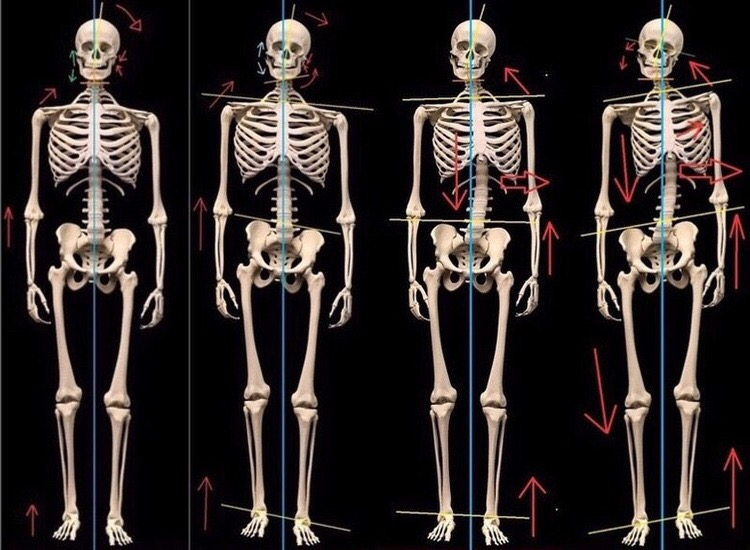
There are several stages in the development of scoliosis. Depending on the degree of curvature of the spine to the right or left, scoliosis is conventionally assigned one of four grades. Such pathological spinal curvature usually develops without symptoms and only makes itself known once scoliosis has already passed through its early stages. In this article we will consider why scoliosis develops from a biomechanical perspective and, most importantly, which treatments biomechanical science offers for passing through these stages of scoliosis in reverse.
Biomechanical causes of scoliosis
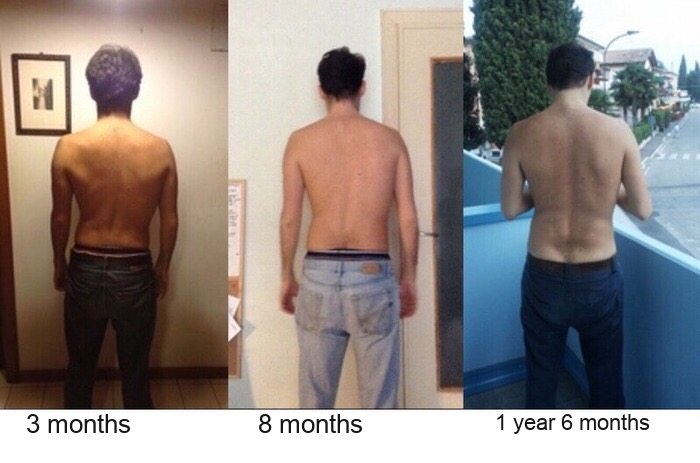
In the photograph above, we see the results of biomechanical treatment for grade-three scoliosis. How does biomechanics achieve this? To understand, we need to look at the differences between conventional medicine's approach to scoliosis treatment and biomechanical methods. Alongside injuries, conventional medicine attributes acquired scoliosis to an internal predisposition of the body—weak back muscles and remaining in an uncomfortable position for a long time. Nevertheless, the prescribed treatment, consisting of recommendations to strengthen the muscles and have massages, and even manual therapy, has little effect. Why?
The thing is that biomechanics, which views the body through an engineer's eyes, takes a much broader view of the problem. Its numerous studies—already more than a hundred in the medical literature*—have determined that scoliosis develops because the skull's weight presses unevenly on the spine: lacking adequate support from the dental arches, the skull sinks, lowers and twists. It thereby has a similarly deforming effect on the spine, as can be clearly seen in the animation and at the third minute of the video by Italian osteopath, physiotherapist and posturologist Valerio Natale shown below.

How jaw displacement causes scoliosis (4 stages)
Here we will examine in detail the four stages that lead to changes in the position of the skull, the physiological curvature of the spine and its twisting. It is logical to begin by describing phase 0. At this stage, we concentrate on the skull, since this is where the process leading to scoliosis begins.
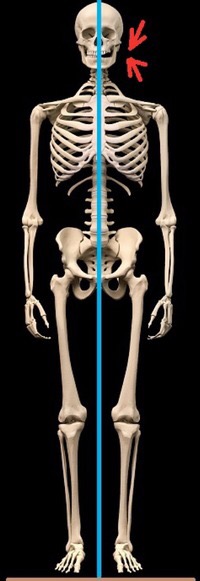
The skeleton in the drawing represents a standard extremely rarely found in nature; we will consider the skeletal form normally encountered in life. In that case, tooth height is reduced to some extent in some part of the jaw, and changes in skull structure are observed. For example, the image below (stage 1) shows reduced tooth height on the left. As tooth height decreases on the left, the skull loses its support on that side. The skeleton, no longer perfect, begins changing towards asymmetry and scoliosis.
Scoliosis stage 1

In scoliosis stage 1, the skull, forced to tilt to one side or the other, becomes asymmetrical relative to the body's central vertical line. This triggers a chain reaction in the rest of the skeleton. As the skull lowers to the left, the facial musculature in that region contracts and, as a counterbalance, the right shoulder begins to rise. The entire right side of the body consequently begins rising, forcing the pelvis to rotate clockwise. Pelvic rotation draws up the right leg and changes the support of the right foot. Symptoms in phase 1 are still mild; muscular tensions are not excessive and are not yet outwardly apparent.
Scoliosis stage 2

In the second phase, changes in the skeletal system are already visually noticeable. The descending nature of this phenomenon becomes clear. The skull tilts towards the jaw on the left, where it lacks support. As the skull's tilt to the left changes, the right shoulder moves upwards. The muscles on the right side of the body begin contracting, rotating the pelvis still further clockwise. The substantial difference between stage 2 and stage 1 is the degree of jaw tilt, which reduces the distance from the skull at the point where tooth height is insufficient. Because the jaw's tilt changes, the geniohyoid muscle group and front of the neck begin to assume an asymmetrical position.
Because of non-physiological blood circulation, these muscular tensions begin to provoke a range of symptoms in the neck. The left side of the body becomes tense and spasmodic. As the skull's tilting and lowering progress, intervertebral compression increases. Finally, the right side of the pelvis rises, changing the structure of the foot arches. Posturologists propose solving this problem with insoles, but clearly this is only a local solution, since the problem originated elsewhere. Conventional medicine considers this stage of scoliosis 'within normal limits'.
Scoliosis stage 3

At this stage, the body begins undergoing fairly serious changes, including outward ones. In this phase, we see two major differences from the previous one: 1) the skull continues rotating towards the left shoulder while the jaw deviates from the vertical line; 2) the jaw changes its tilt again, becoming parallel to the ground. As the jaw's tilt changes, the skull continues rotating because it is lowering to the left. Moreover, at this stage the back muscles begin pulling it backwards. This leads to the visible manifestation of scoliosis. To counterbalance the skull's lowering to the left, the muscles on the right side of the body begin going into spasm.
At this point, the central part of the back begins curving to the left. This happens because the contracted muscles on the left side of the body begin pulling the spine along with them. At this point, the skull's centre of mass returns to its axis to reduce muscular tension on the right side of the body. This phenomenon causes scoliosis. At the same time, because of muscular contraction on the left, the pelvis continues rotating anticlockwise. In this state, the shoulder, pelvis and foot lines become almost parallel. Because of increasing tension at this stage and significant compression of the arteries, diaphragms and internal organs, a person may develop serious psychological symptoms, as well as worsening physical symptoms (herniated intervertebral discs and gastrointestinal problems).
Scoliosis stage 4

At this stage of scoliosis, the muscular compensations created in the previous phase worsen. As the drawing above shows, the skull continues tilting to the left. This is precisely why the body finds a new way to compensate through the right shoulder, which lowers. The lowering of the right shoulder depends on two simultaneous, interconnected phenomena: 1) the musculature on the right side tenses to its limit; 2) to return to its axis, the skull provokes increased spinal curvature, with the spine bending sharply to the left. Both phenomena contribute to the lowering of the right shoulder. Meanwhile, the pelvis continues rotating clockwise, pulling the muscles on the left downwards. We thus obtain a higher left hip, which draws up the left leg, making it shorter than the right. The chest and ribs are compressed in muscular spasm. The neck muscles are tense and painful. Because their lengths differ, they work asymmetrically, forced to adapt to the compensatory situation. But is it possible to pass through all these stages of scoliosis in reverse? If so, how?
Biomechanical treatment

There are two types of biomechanical treatment for scoliosis: one is called ALF orthodontics (whose results we can see in the photograph above); the second is the Italian Starecta method. Both treat scoliosis by acting on the cranio-jaw system and changing the jaw's tilt relative to the skull. Through the intraoral ALF appliance, orthocraniodontics eliminates deformations of the cranial bones; through lower-jaw splints and additional techniques, it balances the body structures below. This appliance was developed in the eighties by American researcher Darick Nordstrom, and in our country this field is represented under the name orthocraniodontics.
The Starecta method is a unique technique for eliminating spinal deformations and achieving a symmetrical body state. It achieves this effect through a special intraoral appliance, the Rectifier, which acts on the principle of a lever: placed on the large molars at the back of the lower jaw, it stretches the back of the neck and lifts the skull. The appliance also provides adequate support for the skull at the front on the lower jaw and centres the jaw. Consequently, the skull returns to an upright position relative to the body's central axis in all projections. This method was developed intuitively by an ordinary Italian man named Moreno Conte, who was experiencing a twisting collapse of his body, based on Italian doctor Adriana Valsecchi's research into the effect of the bite on posture. Its effect on the body is shown schematically and in practice below.

It should be noted that orthocraniodontic treatment is possible only with a doctor, while the Starecta method is used independently according to a specific technique. By acting on the body's jaw system, both biomechanical methods achieve results in scoliosis treatment considered impossible from the perspective of conventional medicine.
Atlas and jaw: why manual neck correction does not always help—here.
How I straightened my spine—here.
________________
*In the 'Resources' section of https://biomechanical-dystonia.net


18 comments
Ask a careful question or add useful context. New comments are reviewed before publication.
Craniodontics: the best specialists
Noah Nikolaevich Kryzhanovsky, dentist, chief physician of “SKD – Center for Functional Dentistry” and chief physician of “PerioCenter – Center for Periodontology,” another city.
https://skdent.com.ua
http://101stomatolog.com.ua/specialisty/krizhanovskij-viktor-nikolaevich-s.k.dent.html
You can find related materials in this archive.
Oleksandr Yuryevich Opekha, prosthodontist at “SKD – Center for Functional Dentistry”
https://skdent.com.ua
http://101stomatolog.com.ua/specialisty/opeha-aleksandr-yurevich-s.k.dent.html
You can find related materials in this archive.
Craniodontics: the best specialists
Craniodontics: the best specialists
Here is a photo and case description of treatment with the Starecta method for a man who was 42 at the start of treatment:
Dystonia: an experience of biomechanical treatment (available later)
The author also reported accounts by people using the method who were much older, over 50.
Are there any specialists in Krasnoyarsk?
You can find related materials in this archive.