

It is thought that the concept of beauty depends on the era and its culture, and that inner spiritual beauty is preferable to physical beauty. But why, then, are we so often dissatisfied with our physical bodies, and why do we want so much to be beautiful? Why do we so admire bodily symmetry and unconsciously find it attractive? In search of answers, let us turn to ancient knowledge and modern discoveries, and find out just how natural our striving for beauty and symmetry is…
Is symmetry attractive?

On the internet, you can find many photographs of celebrities with two halves of their faces combined in Photoshop, which looks rather frightening. The people behind these tricks are trying to demonstrate that symmetry is ugly and unnatural. However, if we look more closely at the original photographs, we can notice that the halves of the faces in them are completely different and have nothing to do with true symmetry. If we look at a genuinely symmetrical face, on the other hand, it cannot fail to captivate us.
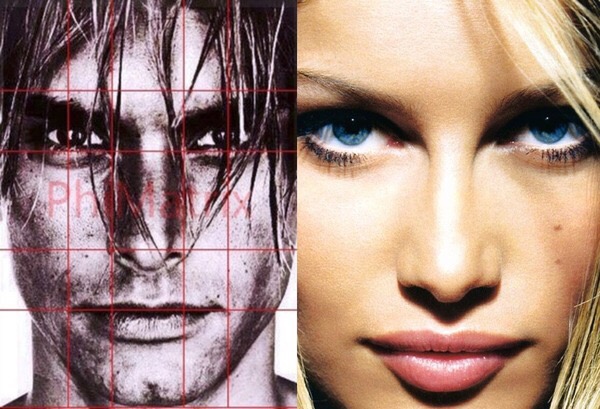
Scientific studies indicate that much of what spontaneously evokes admiration in a person and is perceived as beautiful is directly related to facial and bodily symmetry. It is symmetry that people throughout the world unconsciously equate with attractiveness. Moreover, we usually call something beautiful when it is proportionate. As far back as the school of Pythagoras, which linked beauty and mathematics, it was noted that objects whose proportions conform to the golden ratio, widespread in nature and in the structure of the Universe, are perceived as more beautiful.
The spirituality of beauty and symmetry

Moralists hastily condemn today's ‘beauty madness’ as the ‘evil influence of the West’, brought about by multinational cosmetics companies and harmful mass media, forgetting that the painting, sculpture and literature of one of the world's oldest spiritual cultures — India — were highly eloquent in extolling ideal female forms and the proportionality of the female face and body. Goddesses in Ancient India were depicted as sensual and beautiful, and at least a thousand years before the Christian era began, there was a tradition of nagarvadhu: choosing the most beautiful woman in the city. Being awarded this title was a great honor, and the beauty was subsequently revered by the people as a goddess. Numerous Buddhist texts describe a dialogue between the legendary nagarvadhu Amrapali and the Buddha himself, who acknowledged her unearthly beauty. The ancient Indian physician Charvaka studied bodily symmetry thoroughly in diagnosing disease, and the famous Sanskrit poet Kalidasa said that ‘beauty possesses spiritual qualities’.
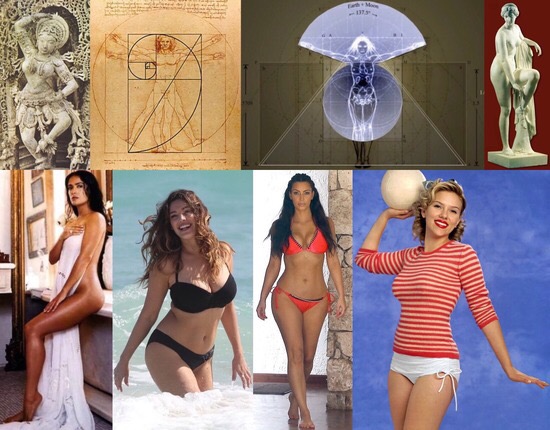
Surprisingly, all the temples of Ancient India, Egypt and Greece, and some medieval European temples, were built precisely in accordance with the proportions of the ideal human body. The point is that ancient people considered the human body a reflection of the perfect structure of the Universe, and temples a place where a person could reset their ‘settings’ to the perfect universal standard. Leonardo da Vinci's famous ‘Vitruvian Man’ drawing was based on the definition of human bodily proportions described in a treatise by the ancient Roman architect Vitruvius. He, in turn, drew his knowledge from the ancient Greeks and Egyptians. Modern research in evolutionary biology and psychology has confirmed a direct relationship between the degree of bodily symmetry and the assessment of attractiveness. It was observed that even small children look longer at symmetrical people. But why do we unconsciously admire this bodily symmetry so much?
Devious DNA

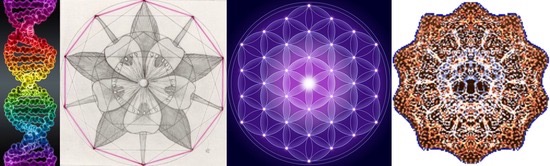
We can find an obvious answer in nature's ‘magical trap’, formulated by Charles Darwin as natural selection. There really is some truth in this: in ancient times, people somehow had to make sure that they produced healthy children so that the best genes would be passed on to subsequent generations. Since DNA tests had not yet been invented, our ancestors relied on instinct: the more symmetrical the body, the better its chances of survival. Indeed, symmetry is considered an indicator of a person's level of health: scientists have proved that people with symmetrical bodies cope better with physical and psychological stress, are more resistant to disease, and are more energetic and fertile. That is precisely why, at an unconscious level, attractiveness and health are one and the same. Physiologically, attractiveness is an indicator of health and genetic quality.
Evolutionary psychologists believe that the human mind consists of thousands of modules, one of which is designed to recognize the ‘ideal partner’. These modules retain information over the centuries, which is why a person never makes a mistake when instinctively choosing the right partner: here, the ‘experience of previous generations’ operates on the basis of the ‘call of DNA’, which is life's ‘building block’, its ‘key’, its ‘source code’. But this is where a surprise awaits us: if we look at a cross section of the DNA molecule, we get… an exact replica of the ten-sided golden-ratio ‘beauty mask’, symmetrical in every respect — the universal Matrix of beauty!
It turns out that nature itself has ‘written’ the symmetrical human body as a standard into DNA's original ‘code of life’! That is precisely why, for thousands of years, the perfect earthly woman has been considered a golden-ratio woman of average height with a hips-to-waist proportion of seventy percent. For centuries, it is this healthy woman whom men have perceived as the ideal of beauty, capable of inspiring a hero to a great deed, and a musician or poet to the most elevated creativity. Of all the women known on Earth today, the body of the famous Hollywood actress Scarlett Johansson is closest to the ideal: it is 96.4% close to the golden ratio. Not far behind this ideal are Kim Kardashian, known for her curves, British model Kelly Brook, and the gorgeous Mexican Salma Hayek.
Can symmetry be achieved?
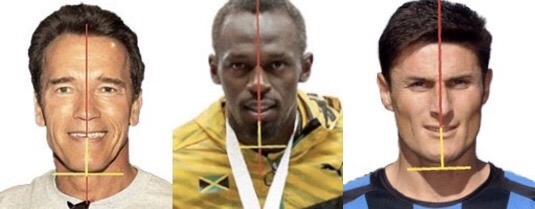
That is all wonderful, you may say, but few of us are born symmetrical — and you would be right. Ninety-eight percent of the Earth's population are in this asymmetrical state. People with asymmetry have their own charm and also achieve success in life, but how long can the human body's biomachine last in such a state? As for mechanics, we can demonstrate the importance of symmetry with a small example: a car is designed so that its left half mirrors its right. Try to imagine a car with a crooked frame: hardly anyone would ever buy it. This is entirely to be expected, since a car with an asymmetrical appearance is much more likely to break down than a symmetrical one.
In fact, an asymmetrical car will subject some of its components to greater wear than others. For example, the weight of such a car will not be distributed evenly over the tires, which will have to support more weight and wear out faster. A similar law is fully applicable to the ‘motorist’ as well. Musculoskeletal symmetry is an essential element if a person wants to get the maximum return from their body. Perfect posture makes the human body super-efficient, capable of carrying out any activity with the least expenditure of energy. Perfect posture noticeably reduces the likelihood that the human body's biomachine might break down in any way: suffer from sports injuries, ill health, lack of concentration, chronic diseases, and so on.
Until recently, medicine considered it impossible to achieve a symmetrical body, but science does not stand still. Craniodontics, the BOS method, Starecta and mewing, which were considered unconventional treatment methods until recently, make it possible to achieve perfect bodily symmetry by acting on the body's dental system. By ‘merely’ adjusting the position of the jaws, both alternative methods make it possible to approach the greatest possible symmetry and improve health and quality of life.
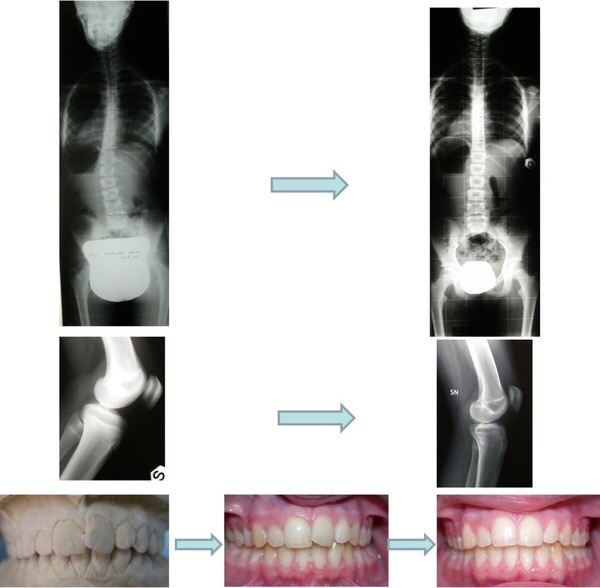
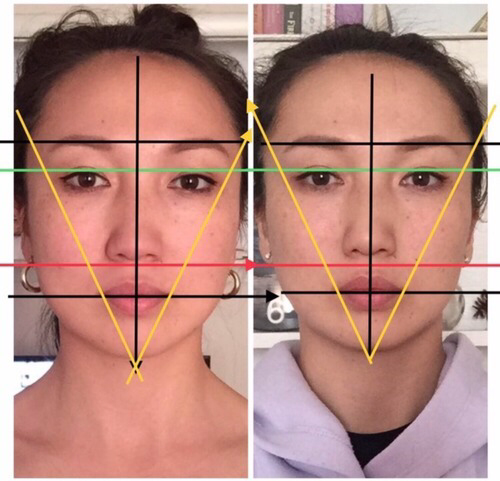
‘Whatever is considered beauty, harmony and unity lie at its foundation,’ said one Catholic priest. Ancient Greek philosophers perceived beauty and symmetry as an objective phenomenon, ontological in its essence, connected with the perfection of the Universe and the understanding of the cosmos as a harmonious world order. The innate human striving for beauty and symmetry thus becomes so understandable: at its foundation lies our desire to return to the natural standard intended by the Universe, a longing for original harmony and wholeness…
High cheekbones: how to get them biomechanically — here.
_________________


4 comments
Ask a careful question or add useful context. New comments are reviewed before publication.
"On the internet, you can find many photos of celebrities where the two halves of their faces have been combined in Photoshop, and the result looks rather frightening. People do this to try to show that symmetry is ugly and unnatural. However, if we look more closely at the originals of these photos, we can see that the halves of the faces in them are completely different and have nothing to do with true symmetry."
Do you mean that these are photos where the celebrity's face is already positioned asymmetrically to begin with? And if a normal photo of the same celebrity were taken and one half of the face were mirrored into a whole face, it would look beautiful? Please explain)
Starecta and mewing: how to reconcile conflicting forces (available later)