
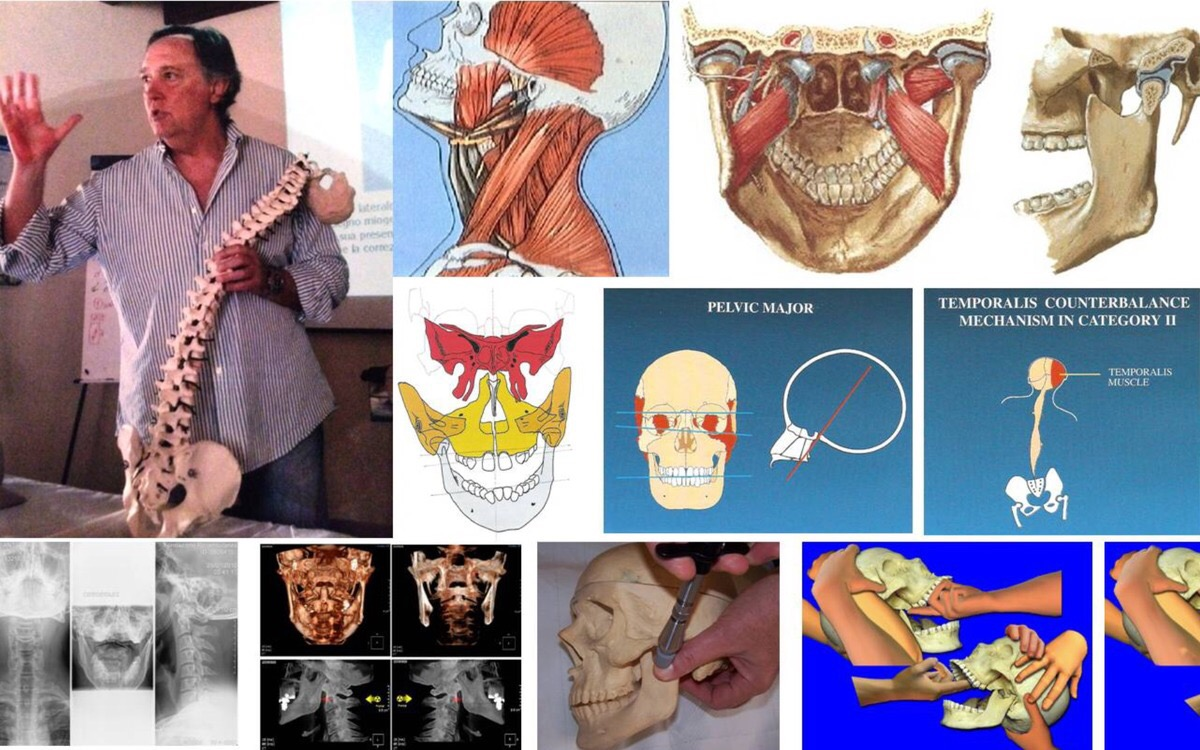
On the pages of this blog, we have more than once discussed the unusual results of the effect on the spine and the structure of a person as a whole by craniodontics, which are achieved by acting on this structure through the human dental apparatus plus the use of osteopathic techniques. This article presents the reflections of one of the most famous craniodontists in southern Europe, the Italian doctor Giuseppe Stefanelli, on why craniodontics and posturology are hardly recognized by the modern scientific world.

The notion that the stomatognathic system is mechanically and functionally connected with parts of the body that are distant from each other fascinates and at the same time interferes with many novice doctors.
The philosopher Karl Popper distinguishes three types of personality in science:
- the one who changes something
- someone who wants to change the situation
- one who does not understand that everything has changed.
The latter category includes those who, despite the conviction that the chosen direction is correct, prefer to rely on the “confidence” of their outstanding predecessors, who believe that everything new is weightless. While respecting the personal choice of each person, we cannot but admit that dentistry and medicine in general are not exact sciences and, as a result, such “certainties” are very often disputed, revised and forgotten.

The study of the relationship between dental occlusion and body position is challenging due to the alleged lack of objectively reproducible “scientific” “cause and effect” results that, if viewed in these strictly limited terms, are likely to never be obtained. It seems that the academic world did not understand that in the 20th century there was a real revolution in science and a radical change of paradigm. The Cartesian reductionist concept gave way to a “systemic” (holistic) vision of science and life, which requires a reassessment of the concept of scientific objectivity.
In the Cartesian paradigm, scientific descriptions are considered objective, which does not depend on the observer and the process of cognition. The new paradigm indicates that epistemology, that is, the understanding of the process of cognition, should be included in the description of natural phenomena and become an integral part of scientific theories. “Science cannot solve the ultimate mystery of nature. This is because, after all, we ourselves are part of the mystery that we are trying to solve” (Max Planck, founder of quantum physics).

Based on systems thinking, the “mother of computer informatics” cybernetics, in an attempt to provide a mathematical explanation for the neural mechanisms underlying the human mind, tries to reduce human intelligence and brain functioning to the state of a computer to such an extent that the process of cognition in it is defined only as information processing. character set conversion based on rule set. Recent developments in the sciences of cognition have clearly shown that human intelligence is completely different from computer intelligence. The nervous system does not process any information, but interacts with the environment, constantly changing its structure. In addition, mind, memory and human decisions are absolutely not completely rational, but are always modulated by emotions. The human mind thinks through ideas, not information, and ideas are integral patterns that follow not from information, but from experience.
“Truly original minds are distinguished not by the fact that they are the first to see something new, they see new in the old – always known, visible, but neglected by all” (F. Nietzsche “Twilight of idols, or how they philosophize with a hammer”).
After that, of course, we will wonder why we never saw what was always before our eyes! Not wanting to run out of rhetoric, the obvious truth is that the excess of technical and sectoral fragmentation in medicine has caused us to lose sight of “the whole person” – in addition to atrophy of our judgment and clinical diagnosis.

Obviously, the concepts of reproducibility and measurability, necessary in order to designate a “scientific” and, therefore, a “true” interpretation of the phenomenon, overshadowed all that does not meet these criteria. The paradox is that in this way we deny the existence of everything that is not yet known and cannot be understood, but it also means denying the possibility of preserving or improving the health of millions of people around the world. Disciplines actually defined as “complementary or alternative” – such as posturology, osteopathy, applied kinesiology, homeopathy and homotoxicology, acupuncture – are victims of this old ideological approach.
In particular, posturology and craniodontics are obscured by two unforgivable inherent sins: the first is represented by the fact that the approach varies from person to person, like our unique digital fingerprint; second, it requires a multidisciplinary approach to be used reliably by all, not just a few actually implemented physicians.

I’m probably delusional, but I think that the study of human posture can really be a leitmotif, a means by which we could all speak the same language. It would now be enough for universities to include this discipline in the examination subjects of all medical specialties.

1 comment
Ask a careful question or add useful context. New comments are reviewed before publication.