
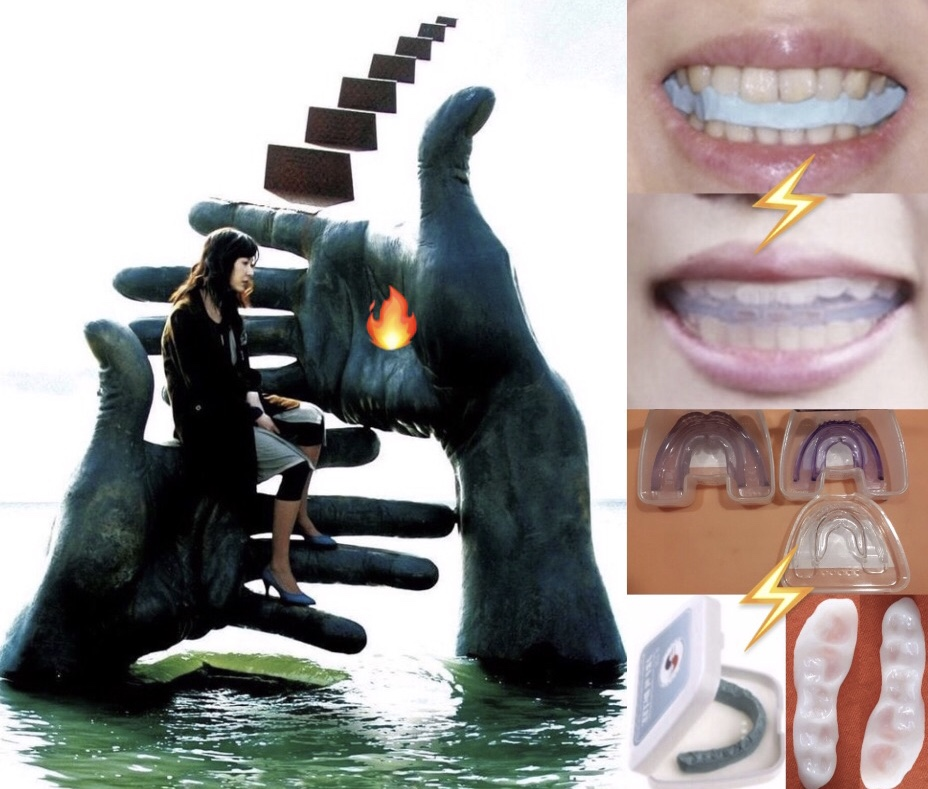
For many months, we’ve been getting the same question: what’s the difference between polymorphic pads and flat mouth guards, including Reviv? So, let’s finally sort it all out in detail — so you can make an informed choice!⚡️
Let’s start with this picture. It comes from an article about a Korean method that includes muscle-relaxation techniques:
And this very article will actually be super useful for today’s topic! Let’s do this! ⚡️
Briefly, this Korean method aims for symmetry using three main components:
1) “Yinyang” tool (similar to Starecta, with pits)
2) Flat mouth guard
3) Muscle relaxation

We’ll talk about the muscle relaxation part later. Right now, what’s important is understanding the first two components ⚡️⚡️
As far as I can see, this method is based on FCST (Functional Cerebrospinal Therapy) — a system developed by the well-known Korean doctor Young Jun Lee. He first stabilizes the TMJ, then works with the skull, and afterward — with the spine and pelvis. During the TMJ stabilization stage, two devices are used: the “Yinyang” and the flat mouth guard. Now please pay attention to how both devices are described:


Notice that the first tool used is the “Yinyang” — it aligns (the cervical spine, TMJ, and CNS). Flat mouth guards are then used for stabilization after the CBA appliance (the “Yinyang” with pits). Why?⚡️
 When you go to a gnathologist, no one will ever give you a flat mouth guard right away — only a splint with pits. Because it’s precisely the pits that help recreate what’s called “Gerber’s bilateral balanced occlusion with condylar-shaped teeth.” That’s what allows the neuromuscular system to stabilize (though, to be fair, gnathologists rarely achieve this well because they don’t work with the position of the upper jaw).
But the same happens in cranioodontics and also in the French OSB method (Organisation Spatiale de la Bouche). Usually, the splints with pits are used first. In the OSB method, activators (flat mouth guards) are used only afterwards ⚡️
 So, for all these reasons, it’s incorrect to compare “Yinyang tools with pits” (like Starecta or polymorphic pads) with flat mouth guards. That would be like comparing rubber and violet. Or like comparing a man and a woman. These two tools simply have completely different functions.
Personally, I have only used polymorphic pads. I wore a flat mouth guard (Myobrace) for a month during the day, only for testing — to understand how it worked. I never did any separate muscle relaxation techniques after beginning with the pads, because the pads themselves fully took over that function. But many people still ask how Starecta differs from polymorphic pads. And most of you are here because I promised to compare Myobrace with the now well-known Reviv. But before we do that — let’s first understand why, if Starecta with pits is supposedly so great, its pioneer Ken (founder of Reviv) couldn’t complete his treatment with it.
Why It Didn’t Work for Ken
I began my Russian-language blog by describing precisely the Starecta method. The Spaniard Marcello and the American Ken, the pioneers of Starecta, became almost like family to us. Marcello’s story shocked and outraged many — but the fact that he managed to correct at least part of his condition gave hope. Ken, in particular, felt close to us, because his wife was from Ukraine, and he himself had lived for a long time in the former USSR.
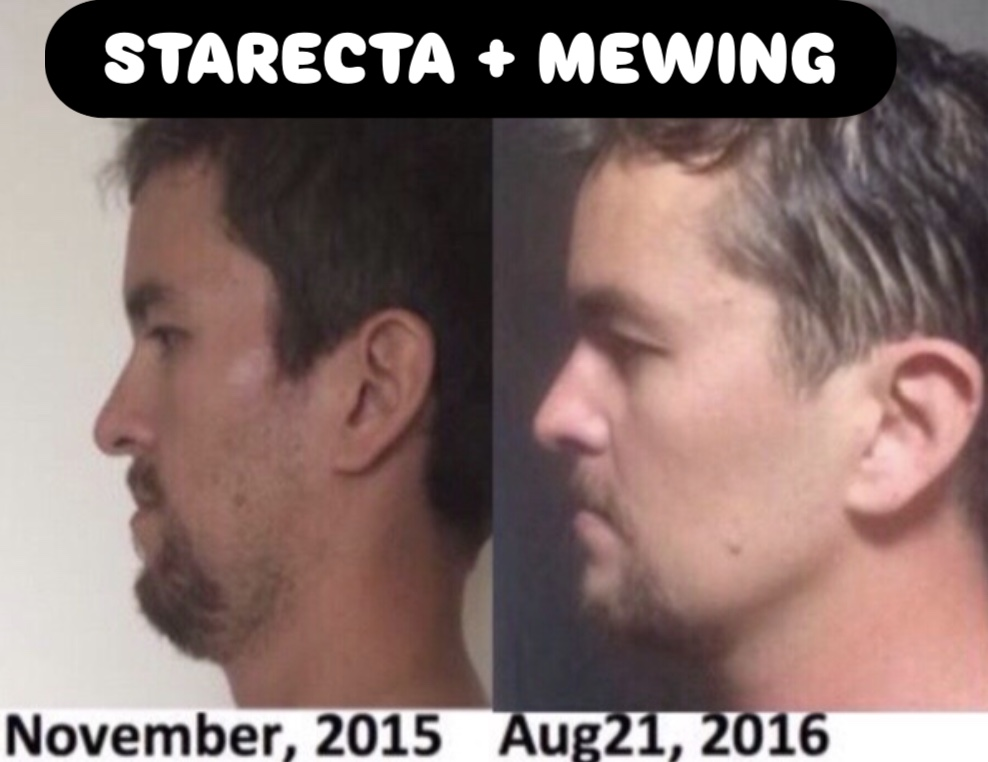
Everything Ken described in his exhausting struggles resonated with a huge number of desperate people. Everyone worried for him, followed how his story would end, and read everything he posted on Facebook. Ken went further in his search. He began working with the upper part of the skull — practicing mewing, myofunctional therapy, experimenting with Myobrace, then with ALF. At some point he wrote some harsh things to the founder of Starecta, criticized ALF, shut down his blog, and disappeared. You could feel it — he was angry, sincerely exhausted.
We could understand how he felt. For many people, the brilliant Starecta brought enormous relief from symptoms — yet turned out to be only one piece of the puzzle.  For example, this English woman, Linda, significantly improved her posture and overall well-being by balancing the position of her lower jaw, but she didn’t know what to do next — with the disconnected occlusion and position of the upper jaw. Many of my readers wrote to me: “I’d rather live the rest of my life with a crutch in my mouth than become disabled again.” But as you can see, that’s the main problem: after Starecta, many people face the fact that without the splint, they have no occlusal contact at all. That was also Ken’s problem — an open bite.
How We Found a Way Out
My readers experimented endlessly — trying to influence the position of the upper jaw and bring back occlusal contact. First of all, there was mewing — and people really had success. But still, Starecta acts too powerfully compared to the gentle force of the tongue. Then, in 2019, my colleague Anna appeared with her interoral face pulling techniques — and everything changed. A new kind of biomechanical treatment had emerged — strong enough to balance the influence of Starecta.
 I wrote in my blog about one of our readers, Vladimir, who experimented with Starecta and mewing. But after that article came out, he also tried interoral face pulling, and just after one session, his palate shifted position, moved forward, and the tongue naturally took more of a physiological place on the palate.
 Interoral face pulling turned out to be so powerful that many of my readers gave up Starecta completely. By working with the upper part of the skull, the lower jaw began to adapt to it, the head aligned on the neck, and posture improved.
A week ago, someone sent me his new blog. I was surprised to see that in one of his articles he put our system in the same category as simple thumb-pulling. He also said he had done “intraoral facepulling” back in 2015. Apparently, by that he meant pulling the face forward with a hockey mask — something another Starecta pioneer, Plato Powers, used to do — or perhaps some myofunctional tongue technique. (That’s probably a topic for a separate post, otherwise confusion arises — because our system appeared much later.) It’s a pity, really, that such a thoughtful researcher spoke of us a bit superficially. When he was asked about our techniques, he didn’t discuss our techniques — instead, he immediately mentioned polymorphic pads. So let’s talk about that too.
Are Polymorphic Pads the Same as Starecta?
First — a little background (bear with me, it gets more interesting soon 🙂. Many people using these techniques don’t use pads at all. My colleague Anna used muscle relaxation techniques to help the muscular system adapt to skeletal-level changes.
I personally never tried Starecta, because I was undergoing craniodontic treatment. My occlusion was separated for five years. After I stopped the treatment, I had no occlusal contact at all. None. I had a pretty strong cross-bite. My jaws didn’t match. There was pinching of the glossopharyngeal nerve — and basically everything inside my head. It took me ten months to develop the advanced techniques.  I also intuitively felt the need to stabilize the lower jaw — but I was afraid to touch it, afraid to lose the precious space opened up for a missing canine. One day I snapped. I filled the space of that missing canine with polymorph, and applied it right onto my teeth ✨✨
That was a breakthrough. The “cherry on top” that helped stabilize my neuro-muscular system. Since then, we’ve used the pads in all cases involving neurological symptoms (just like in Starecta). Our practice also showed they’re essential for torsion strains — the most difficult type to correct — for severe or combined strains, deep bite, and for extracted wisdom teeth (especially asymmetrically).
But the key moment for me was that I physically felt with my whole body the desire to have my canines touch during pad activation. It took me 3–4 months of upper-cranium work to reach contact on the canines — but when I finally did, it was a completely new level of the game!  I could feel — it was somehow connected to energy, to the energetic chains inside the body that began to merge into a single whole. Before that, they were simply broken behind my face. (I’ll write a separate post about this — and about why the canines are so crucial for the biomechanics of the body ⚡️⚡️)
So, the essence of it all: work with the spatial position of the upper jaw in 3D + provide support from below to balance the lower jaw and deprogram the muscles. As adaptation continues, occlusal load gradually shifts —from canines to the fours, then to the fives, and finally to the molars! Now, three years later, it’s strange to even recall that I once had no molar contact at all…
 I was intuitively rebuilding my face from the inside —
and this one image resonated so deeply with me: vectors from each tooth converging at a single point, the Crista Galli, behind the forehead — the so-called “point of truth,” the bindu that Hindus mark on their forehead. We have a magical community —and just a week ago one girl sent me an image with a name! Now I finally know what I had been putting together – with my fingers behind my face all this time —the Curve of Monson! ⚡️⚡️⚡️
The Main Differences Between Polymorphic Pads and Starecta
So, let’s summarize the key distinctions:
 1️⃣ Polymorphic pads are used only in combination with active work on the upper part of the skull in 3D.
2️⃣ We don’t use any splints. The polymorph is applied directly on the teeth. Even microns of splint material can add unnecessary height or bulk, interfering with the natural adaptation between the jaws.
3️⃣ Pad activation happens only after an interoral face pulling session — when an internal impulse has already been set, directing the cranial bones to move in the desired way.
4️⃣ The pads are extremely thin, but the edges are made high, forming a kind of intuitive contact surface where both jaws gently meet and move in all directions. Through this micro-motion, the smallest muscles are activated, helping both jaws very effectively adapt relative to each other.
5️⃣ Re-activation of the pads happens daily, sometimes two to three times a day, to immediately adapt the position of the lower jaw to the new cranial changes and to deprogram the muscles under these new spatial conditions.
 6️⃣ Activation occurs at the canines. If this contact isn’t there initially, we achieve it through intensive cranial work. Proper activation on the canines allows the occlusal load to gradually shift to the molars.
7️⃣ After each interoral face pulling session, activation of the pads creates a “hook effect” behind the back molars. When you intuitively press your lower jaw upward, this hook helps move the upper jaw even further forward and upward, speeding up molar contact.
✅ As we can see, the biomechanics of polymorphic pads are fundamentally different from Starecta. The only similarity lies in the creation of condyle-shaped surfaces on the teeth. And now let’s talk about flat splints, the Myobrace, and, of course, the increasingly popular Reviv ⚡️
Let’s begin with Myobrace (and its Chinese analogs) — and explain what we have experienced when using them
 1) To align teeth in cases of mild or moderate crowding
2) To form a proper U-shaped arch instead of a V-shape (which is especially important for narrow lower arches)

To understand Reviv, I used two sources: 1) independent reviews; 2) my own experience.
1) At first, I tried reading about it on Reddit. But very quickly my ears “wilted” — most of the people leaving negative comments clearly had never tried this tool, but still had a very “strong opinion.” So I decided to ask people about their experiences instead — people I know and trust. There were eight of them. Among them: 2 negative reviews, 2 positive, and 4 neutral. The most extreme negative one reported facial recession (though that person was also doing random Internet thumb-pulling.) Most others combined Reviv use with interoral face pulling, so not a controlled case. But one of the strong positive reviews was that a participant’s dizziness subsided significantly. Another, with a neutral review, wrote simply

 2) When I first unpacked Reviv (with big interest!⚡️⚡️), my immediate thought was: “This thing is huge for me!” It was exactly the size of Myobrace L — and back when my palate width was 35.5 mm, that size felt oversized. But as soon as I put Reviv L in, I realized the difference. In Myobrace, the back part is way too long — even for my elongated jaw — and that was what caused discomfort. Reviv doesn’t have this issue! I tested both in a dark room, switching them back and forth to focus purely on feel and biomechanics. And I can tell you — they act almost identically. But! The material of Reviv 1 — oh my God! Compared to the stiff Myobrace A1, Reviv feels like silk in your mouth! I’ll share detailed impressions and close-up photos in my stories later — there isn’t enough space here. But let’s make one thing clear: we’re comparing Reviv vs Myobrace — not vs polymorphic pads — because their functions are completely different ⚡️⚡️
What Is Your Goal?
You need to be clear about why you’re wearing a particular tool (whether it’s something with pits or a flat mouth guard) — what’s your goal? My own goal was to align both jaws in 3D, bringing them powerfully forward and upward, while also achieving strong molar contact. After all, it’s precisely that molar contact that gives a person a sense of confidence, vitality, and inner strength. Now, exactly three years into the full system with the pads, that half-crazy state I once lived in — with my occlusion completely disassembled and no contact at all — feels like a faint memory from another lifetime.
 But you might choose another path — to separate your occlusion and later rebuild the missing tooth height with composites. This is your body, and only you can decide what to do with it. My task is to provide the most well-rounded information possible so that you can make an informed choice. If you have any thoughts or questions about this — let’s talk about it in the comments! ⚡️⚡️
3 comments
Ask a careful question or add useful context. New comments are reviewed before publication.