

Many patients interested in biomechanical treatment methods ask how the ALF appliance differs from the intraoral Rectifier device used in the Starecta method. But comparing them is like comparing a starter with a dessert, since these two appliances perform completely different functions. What these functions are, the purposes for which both devices are used, how orthocraniodontics relates to them, and the advantages and disadvantages of both techniques — we will try to understand all these subtleties in this article.
The functions of the ALF appliance and the Starecta Rectifier

First, let us look at what both devices are used for, the principles on which they function and how they differ.
The ALF appliance is fitted to the upper jaw and used to release the cranial sutures, eliminate torsions (twisting) and displacements of the cranial bones, expand the dental arches and create adequate space for normal tongue posture, which is extremely important for developing the ‘adult’ swallowing process. The appliance functions on the principle of gentle force on which cranial osteopathy is based: a technique of gentle influence on the skull bones (including the facial bones), fasciae and meninges. A deformed skull often resembles a deflated balloon, as shown schematically in the illustration below. Acting simultaneously in three directions, the ALF appliance allows this process to be reversed. In addition, ALF helps achieve symmetry and forward-horizontal facial development, significantly improving facial aesthetics.

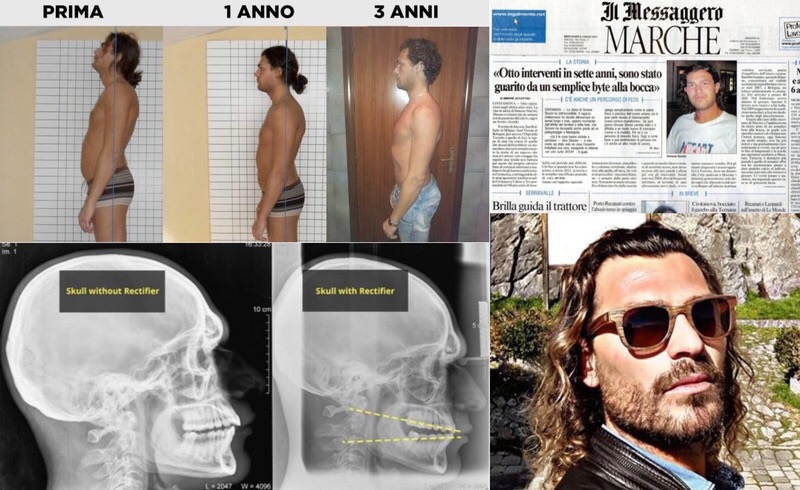
The intraoral Starecta Rectifier device acts on the principle of a lever which, when placed on the molars at the back of the lower jaw, stretches the back of the neck and raises the skull. In addition, the device provides adequate support for the skull at the front on the lower jaw and centres that jaw. In this way, the Rectifier decompresses the temporomandibular joints and returns the skull to a vertical position relative to the body's central axis in all projections. To activate the ‘lever’, the Starecta Rectifier uses orthopaedic forces produced during the swallowing reflex. Through the hyoid bone and the complex system of neck muscles, this process rebalances all the lower structures of the body and returns it to symmetry. In the process, the vertebrae, internal organs, fasciae, diaphragm, veins, arteries and nerves are decompressed. Thus, the Starecta Rectifier is used to eliminate spinal deformities — scoliosis, lordosis and kyphosis — and to treat dystonia associated with compression of internal structures, nerves and arteries.

The ALF appliance therefore differs from the Rectifier in that it balances the skull bones, restores normal ‘breathing’ of the cranial sutures, expands the dental arches and improves facial aesthetics, while the Rectifier provides adequate support for the skull through the dental rows on the lower jaw and balances the body, returning it to a state of symmetry. While ALF acts mostly in the directions of the horizontal plane, the Rectifier acts more in the vertical plane. The ALF appliance is fitted to the upper jaw, and the Rectifier to the lower jaw.
Combined use of the appliances and orthocraniodontics

As you have already guessed, these two intraoral devices complement each other, noticeably increasing treatment effectiveness. Some users of the Starecta method noticed this and reached the conclusion through experience. One of the most active experimental researchers into the interaction of these two appliances was the Spaniard Marcelo Massa, who developed a serious case of dystonia with spinal cord compression after an ignorant dentist ground down his tooth contacts on one side. With the support of the well-known American TMJ treatment specialist Jeffrey Brown, he developed a biomechanical method for treating dystonia, whose foundational treatment device is the Starecta Rectifier splint.
The thing is that the ALF appliance is a powerful tool for treating cranial deformities, but on its own, without a device to balance the lower jaw, it becomes as ineffective as an army without a commander. The Rectifier splint, which instantly relieves symptoms caused by compression of the neck structures, is indispensable in this respect. However, on its own, the Rectifier, which has a powerful influence on the body but only a mild expanding effect on the upper jaw, cannot eliminate torsions (twisting) of the skull structures. That is why use of the ALF appliance is important in cases of severe neurological symptoms associated with dystonia, Tourette syndrome, Parkinson's, multiple sclerosis, blepharitis and so on.
Many people ask which to use first: the Starecta Rectifier splint or the ALF appliance. Everything here depends on what primarily troubles the person: compression and deformation of the cervical structures and spine as a whole, or facial and ‘head-related’ symptoms. The founders of the Starecta method officially warn that the technique does not help with facial pain (although many users of the method have reported a reduction in such symptoms in discussions). Still, in such cases it is better to see a competent orthocraniodontics specialist straight away. After all, along with the ALF appliance, orthocraniodontists also use balancing orthotics and expanding appliances on the lower jaw, as well as other orthodontic techniques, including elastics and manual techniques for cranial skull deformities. It is orthocraniodontics that brings together the upper- and lower-jaw appliances.
Orthocraniodontics versus the Starecta method

Advantages and disadvantages of orthocraniodontics
Orthocraniodontics skilfully uses upper- and lower-jaw appliances, adjusting the angle of the jaw relative to the patient's skull and cervical vertebrae with literally jeweller-like precision. It ‘finishes’ the patient's dento-maxillary system in the literal sense of a ‘turnkey’ solution. The thing is that, during treatment with both orthocraniodontics and the Starecta method, the patient's habitual pathological occlusion is ‘broken’, since the primary task of biomechanical treatment is to stabilise the patient's temporomandibular joints, not to bring their teeth together and literally look only inside the mouth, as traditional braces-based orthodontics does. Orthocraniodontics stabilises the cranial structures at the beginning of treatment and only aligns the dental occlusion at the very end. After treatment with the Starecta method, the body's structures stabilise, but to align the occlusion the patient must either see a specialist or constantly wear the splint at night to preserve the results. Treatment with orthocraniodontics does not have this disadvantage.
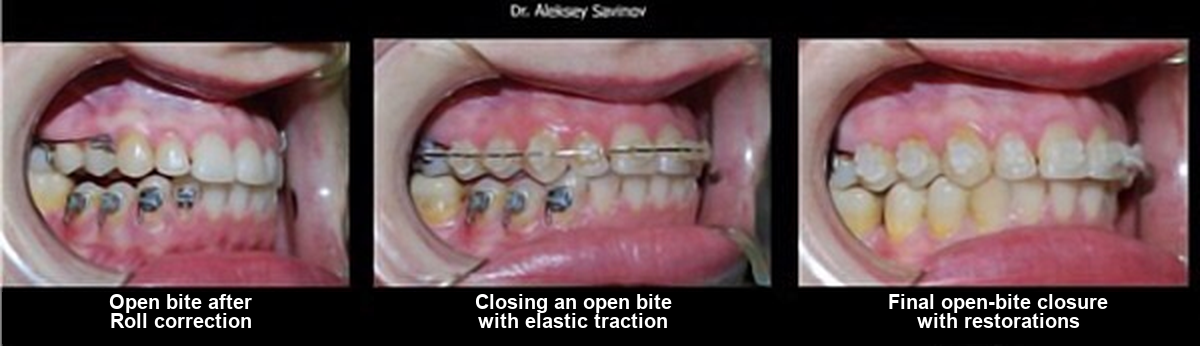
As the last photograph shows, in this case the orthocraniodontist resolved the insufficient bite height by using elastics on braces and a restoration. If you have reached a top-class orthocraniodontist, then despite all the difficulties of treatment, consider half the job done. The disadvantage of orthocraniodontics is precisely that finding, and above all getting an appointment with, a competent orthocraniodontist with sufficient treatment experience in the post-Soviet region is very difficult, since this field is only developing here and these specialists need quite a long training period. Such a specialist must understand not only the biomechanics of the skull, but of all the body's structures. A list of orthocraniodontists in Russia and Ukraine can be found here. In the near future, a list of world-class specialists abroad will appear on the pages of this blog, since this information may be useful to our compatriots living abroad, and perhaps someone will decide to travel to a doctor in a country close to our borders.
Advantages and disadvantages of Starecta

What is really good about the Starecta method is that when the splint stabilising the lower jaw is fitted, patients suffering from dystonia improve within a few hours. The same cannot be said of orthocraniodontic treatment, since it affects the skull structures more extensively, and for this very reason their movement in serious cases can also cause a deterioration in well-being (you can read more about what happens during treatment with orthocraniodontics and the Starecta method here). Moreover, during orthocraniodontic treatment, the expanding effect on the skull structures may cause temporary compression of the cervical structures, since the splint's height will be sufficient only to decompress the jaw joints. Compared with orthocraniodontic splints, through stabilisation of the cervical structures and the ‘stretching’ technique, the Starecta Rectifier immediately provides much more powerful support for the skull through the lower jaw's dental arches and pleasantly stretches the spine.
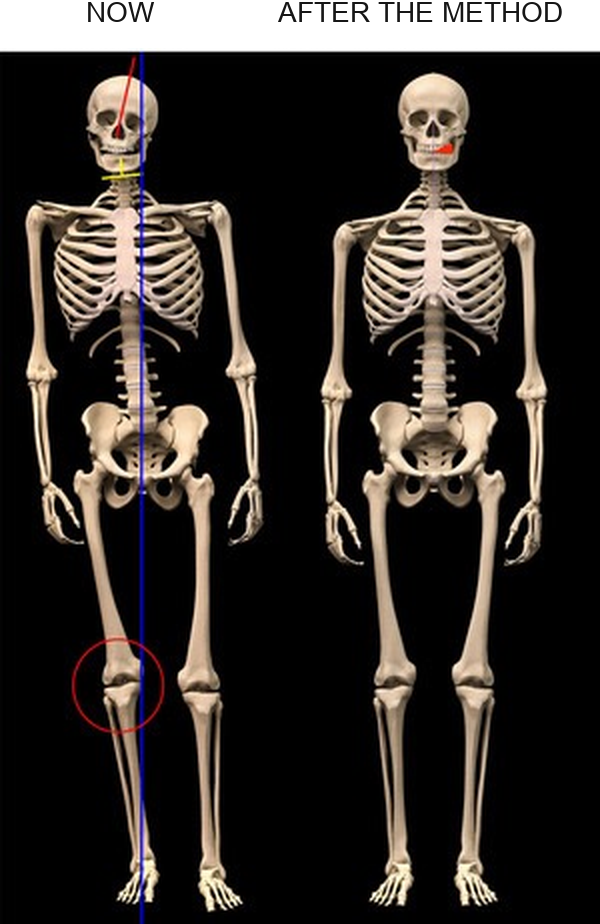
Another advantage of the method is that it is used without a doctor and the patient is entirely independent of one, yet thanks to the established technique, as the saying goes, cannot ‘miss the mark’ (the main criterion for correct splint activation is a test you can find on YouTube: Rectifier Starecta: step-by-step instructions). No time is spent visiting a specialist, and sometimes considerable money is saved on tickets. We have already discussed the method's main disadvantage: its inability to eliminate torsions of the skull structures. Other disadvantages of Starecta include the patient's temporarily unaesthetic appearance, since during treatment the technique involves moving the lower jaw somewhat forwards, which is gradually ‘pushed’ back over 15 days by pulling the skull upwards. After 15 days, this forward jaw movement is repeated when the bite is re-registered. Such a jaw position will even suit men, but women may not like it: not everyone wants to look like ‘Xena the Warrior’, even for the duration of treatment.
Conclusions

So the ALF appliance is useless without devices that stabilise the lower jaw, such as the Rectifier splint of the Starecta method. At the same time, Starecta cannot eliminate torsions of the cranial bones or promote aesthetic forward-horizontal development of the face. Seeing a competent orthocraniodontist resolves this dilemma, but that is problematic because of the shortage of truly experienced specialists in our country. Orthocraniodontics affects the structures far more deeply and comprehensively than the Starecta method, so there may immediately be a deterioration in well-being and slight compression of the cervical structures during it, whereas Starecta immediately improves the condition through its stretching effect on the spine, stabilisation of cervical structures and adequate support for the skull.
Orthocraniodontics provides a ‘turnkey’ solution to the patient's problem, whereas in the Starecta technique this question remains open. As for the price: treatment with an orthocraniodontist starts at €2,000. The current price of the Starecta splint is listed in our shop. Using it saves time and money on tickets to reach a specialist, since the doctor must be visited every month to month and a half, and treatment lasts about two years. Perhaps the best option for biomechanical treatment would be to see a high-class orthocraniodontist. The Starecta technique is good as a foundational tool for treating TMD and dystonia, but it is a unique method in its own right for eliminating spinal deformities and achieving bodily symmetry. Making a choice here really is difficult, but as the saying goes, the hardest choice in life is not between good and bad, but between good and better.
ALF orthodontics: what it is — here.
Specialists' opinions on the Starecta method — here.
________________
10 comments
Ask a careful question or add useful context. New comments are reviewed before publication.