
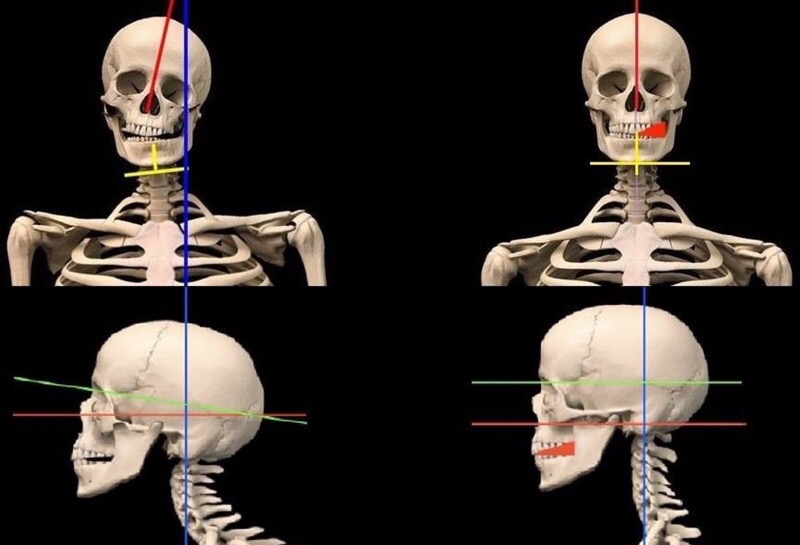
Many people suffering from scoliosis and osteochondrosis ask a perfectly logical question: can osteochondrosis be a consequence of scoliosis, and if so, where is the trigger that sets its development in motion? Many will surely be surprised to learn about the latest discoveries of biomechanical science, which has located this trigger somewhere rather unexpected for traditional scientific thinking: in the system supporting the skull. Nevertheless, acting at this point produces astonishing results that traditional medicine cannot achieve. In this article we will examine these specific results, the biomechanical method that helps achieve them, and look in detail at the development of osteochondrosis and scoliosis from the perspective of the human body’s biomechanics.
The Relationship between Scoliosis and Osteochondrosis
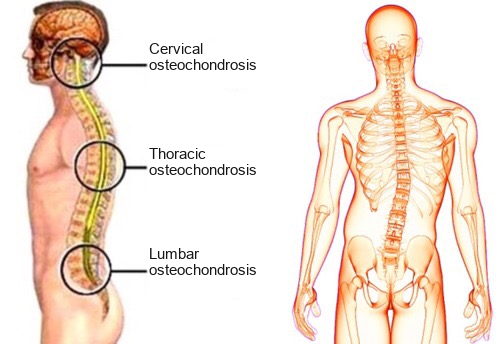
What is osteochondrosis? It is a local problem with the intervertebral discs, which become dehydrated as their height and elasticity decrease. Under continued loading, the cartilage deforms, producing a protrusion or herniation. It begins compressing nerve roots, causing pain and muscle spasms. A disc undergoing such deformation becomes an inadequate ‘cushion’, so the neighbouring vertebrae above and below begin experiencing friction and pressure. In response, they form bony growths along their edges, called osteophytes. As a result, instability develops in entire regions of the spine: lumbar, thoracic or cervical. In later stages of osteochondrosis, the osteophytes begin damaging the already partly destroyed disc and compressing nearby vessels, leading to fairly serious disorders — for example, vertebral artery syndrome in cervical osteochondrosis.
What is scoliosis? Unlike the local problem with discs, this is already a ‘bigger game’, involving deformation of the longest physiological regions of the spine. Uneven shoulder and shoulder-blade heights, a crooked back and even pelvis become quite noticeable. It is not difficult to imagine what happens to the intervertebral discs. So scoliosis and osteochondrosis really are interrelated diseases. Scoliosis produces uneven pressure on the discs, causing changes in them, with neurological symptoms subsequently joining this process. But scoliosis is not the only cause of osteochondrosis. We must not forget that changes in the spine occur not only in the frontal plane but also in the lateral plane, leading to cervical and lumbar lordosis and thoracic kyphosis.
Traditional medicine considers all these changes to result from poor posture. Patients with such problems are offered massage, manual therapy, osteopathy, physiotherapy, sport, muscle relaxants, vasodilators and even antidepressants. But alas, after trying all these treatments, these people hopelessly discover that all these measures, at best, bring only temporary relief and often do not help at all. Yet science does not stand still, and in recent years new studies have emerged in medicine worldwide on the relationship between posture and the position of the skull — specifically, the structural position of the jaws, which has a decisive effect on the entire human body. In other words, osteochondrosis, scoliosis, kyphosis and lordosis originate… in the mouth.
Posture Depends on the Bite


Why are teeth so important for posture? The skull is the heaviest part of our body, resting on the first cervical vertebra, the atlas. But what supports the skull on this vertebra? A few decades ago, scientists believed it was supported by the neck muscles, controlled by a conscious effort to stand upright. But with the birth of the medical field of gnathology, its clinical trials revealed a functional-anatomical relationship between the cranio-mandibular system and cervical vertebral dysfunction. Put simply, researchers in this new field began understanding the lower jaw’s role in the human postural system, and consequently that neck and back problems could be caused by an imbalance between the skull and lower jaw.
But despite this important scientific progress, none of the gnathologists could truly solve the classic postural problems: osteochondrosis, scoliosis, kyphosis and lordosis. They tried a wide variety of methods, none of which led to significant results. Postural problems can be solved only if you know exactly how the cranio-mandibular biomechanism works and the specific relationship between bite and posture.
How the Postural Biomechanism Works

As we already know from the postulates of official science, the skull rests on the first cervical vertebra. As we can observe, the jaw is ‘suspended’ between the hyoid bone and skull and is highly mobile: the temporomandibular joint allows it to move in three spatial planes — horizontal, vertical and sagittal (forward–backward). Given this characteristic, it is hard to imagine that the skull could find support in the dental arches and lower jaw. It is even harder to understand how dysfunction in this area could cause enormous changes throughout the body.

The answer is that the lower jaw becomes a stable structure and performs a supporting function only while the teeth are closed together, with maximum stability occurring during the swallowing phase. During swallowing, all the muscles of the stomatognathic system begin working in a unified movement from opposite directions, joining into a single monolithic complex. It is precisely at this moment of jaw stabilisation that forces caused by tooth contact are transmitted to the structures below. Given that approximately 1,500–2,000 swallows occur during the day, we can say that about 2,000 kg are transmitted daily to the spine and the lower structures of the body (more detail on this mechanism is here). This is a chapter from the book of Italian Moreno Conte, who from his youth suffered many exhausting symptoms related to spinal curvature and could not be helped by any treatment offered by official medicine. Through trial and error in his own experience, he invented Starecta, in which the spine is straightened by aligning the position of the lower jaw.
Results of the Starecta Method


But let us return to scoliosis and osteochondrosis (as well as lordosis and kyphosis) and look at specific cases using the method. In the photograph above you can see Moreno Conte at the very beginning of treatment: at that point he suffered constant back pain caused by compression of the nerve roots of the intervertebral discs. His head was lowered forward, forming cervical lordosis, as well as thoracic kyphosis and lumbar lordosis. By fixing the position of the lower jaw with a special splint and increasing the height between the first cervical vertebra and the skull, Moreno achieved the form shown in the last photograph after a year. Traditional doctors could not believe what was happening was real. It hardly needs saying that all the symptoms tormenting him, including spinal pain, disappeared. In the photograph below you can see Moreno’s friend Valerio Quatrano, who had suffered grade 3 scoliosis for many years when he began Starecta. In his case, back pain was already practically unbearable. In the last photograph you can see an intermediate result after a year and six months of treatment, achieved without any operations. All this allowed him to live a full life.


Starecta is now internationally patented and has attracted the attention of leading doctors around the world in different specialties. In fairness, similar results are achieved by specialists working in orthocraniodontics. Unfortunately, at the time this article was written, there were only a handful of truly high-level specialists in this field worldwide. The Italian Starecta method, meanwhile, offers an accessible self-administered treatment technique that has already helped thousands of people worldwide suffering from postural problems.
Scientific Proof of the Bite’s Effect on Posture — here.
Moreno Conte’s Book ‘How I Straightened My Spine’ — here.
_______________
The article’s cover uses an image from starecta.com


3 comments
Ask a careful question or add useful context. New comments are reviewed before publication.