
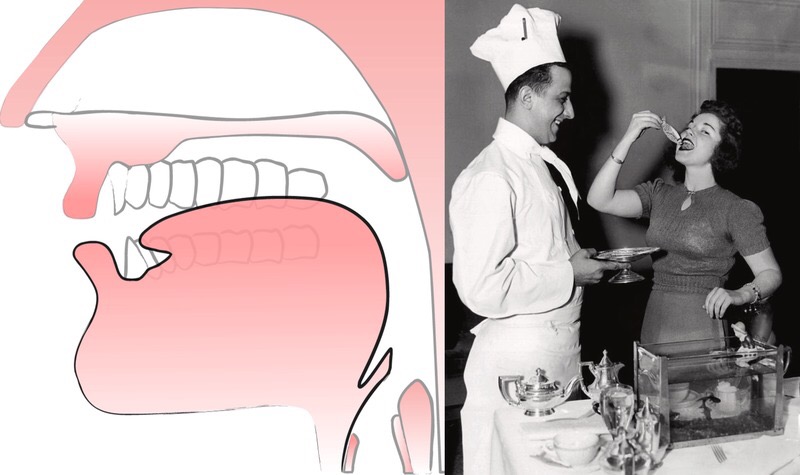
In the previous article about the ‘beauty bone’, the maxilla, we discussed its importance in creating an attractive face. When moved forwards and upwards, the maxilla provides proper support for the eyeballs, raises and beautifully defines the cheekbones, attractively shortens the distance between the nose and upper lip, and creates a stunning broad smile. What pushes this ‘beauty bone’ forwards and upwards is precisely the pressure created by proper tongue posture on the palate and the adult type of swallowing. That is what we will discuss in more detail in this article.
‘Tongue on the roof’

In his many YouTube videos, the British doctor Mike Mew (the orthotropics field of horizontal facial development) constantly emphasises the importance of proper tongue posture. What does it mean? A modern person usually rests the tongue's tip against the area of the teeth. As we learned in the previous article, the tongue's tip should be behind the front teeth, in the hollow on the palate, in the so-called position of the Spanish letter ‘soft ñ’, but that is not all. Even if you try to adopt this position now, the back of the tongue will remain too low in many people.

Proper tongue posture means that not only the tongue's tip is raised to the palate, but its entire back portion is also on the ‘roof of the mouth’, the palate, and literally ‘stuck’ to it. This is precisely what provides additional upward-directed force. Try adopting this tongue position and swallowing. The difference in sensation is enormous. Now the maxilla is pushed forwards and upwards with greater force coming from the back of the tongue and its muscles, which extend deep into the front surface of the neck down to the hyoid bone.

A big difference! Now all the force of these muscles is directed towards pushing up the maxilla, the ‘beauty bone’ that makes your face more attractive. If you compare the maxilla to a sofa, imagine trying to move it alone (as before); when the force of the back of the tongue joins in, two strong friends join you in moving the ‘sofa’. Now the process happens with triple the force!
How the tongue affects maxillary width
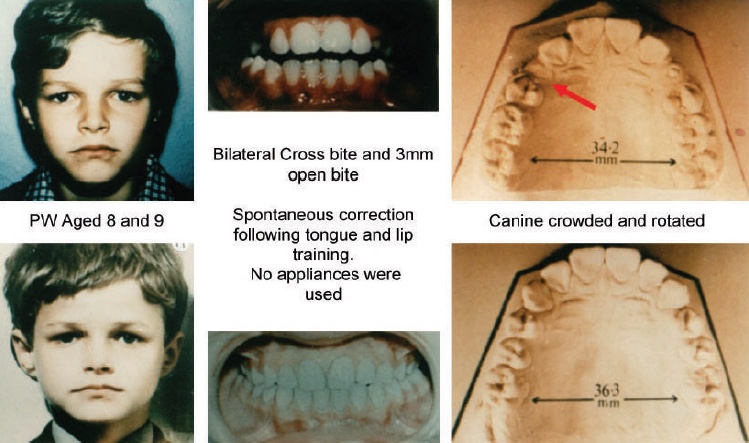
Proper tongue posture, which a child should be taught from childhood, is the determining factor in an even line of teeth that will not later need any alignment appliances or braces. By the age of eight, the boy in the photograph above had developed a bilateral crossbite that was also open. One canine in his upper row was crowded and displaced. We can also see how the malocclusion affected the boy's facial development. The face and bite in the lower row of this photograph are only the result of teaching the child proper tongue posture and, consequently, the ‘adult’ type of swallowing (according to the orthotropics method). Just compare the upper jaw before and after treatment: it has aligned, moved forwards and expanded. I do not think the effect on the boy's facial attractiveness needs any comment!
Benefits of correct swallowing

In the article about the maxilla, we already discussed the importance of breastfeeding for the proper development of a child's oral apparatus and facial muscle tone, and, for the same purposes, the need even for an adult to eat hard food (at least ordinary apples and carrots). This lays the foundation for attractive horizontal facial development and future health as a whole. For example, in the photograph above, you can see the difference in facial development between a brother and sister. The girl's tongue is not on the palate but rests against the teeth, which in her case caused lowering of the maxillae and consequently elongation of the face. Her mother breastfed her for 13 months before switching to artificial bottle-feeding. Unfortunately, using dummies makes the tongue rest not against the palate, as when sucking the breast, but on the floor of the mouth. The same happens with thumb-sucking, which over time becomes a bad habit.
The girl's brother was breastfed for two and a half years without switching to artificial feeding. He first ate solid food at 12 months. We can see excellent muscle tone and magnificent facial development in the boy. Orthodontists also diagnose a correct bite and proper jaw position. Many people may now start blaming genes, but we are talking about a brother and sister. It really is surprising to see such a difference in children's facial development because of different approaches to feeding them in infancy. It is striking that this difference in facial development is already apparent at age 9. This realisation also makes us ask a shocking question: how different is our present face from the ideal face we could have had under favourable circumstances?
How incorrect swallowing distorts facial beauty

Dr Mike Mew emphasises that, in the ‘adult’ type of swallowing achieved through proper tongue posture, all effort is performed exclusively through the force of the deep tongue muscles. With correct swallowing, there should be no activity of the lips or cheeks! Otherwise, unbalanced contraction of the facial muscles causes loss of their tone and, consequently, a ‘drooping’ facial outline with puffy cheeks and bags under the eyes (this effect occurs because the maxillae drop).

Mouth breathing due to weak muscle tone also leads to a low tongue position, sending the process of facial dystrophy into further cycles. Incorrect swallowing also causes tension in the cheek, chin and lip muscles (so-called muscle bands), which leads to expression wrinkles in the future.
The tongue's connection with the subconscious

According to Mike Mew, the back of the tongue is controlled by our subconscious. This means proper tongue posture is literally on autopilot, and once you train it, the tongue will know where and how to position itself without conscious control. In the long term, this means that after some initial effort of will, we will be able to use the power of our subconscious to create an attractive face. The front of the tongue represents an aspect of the conscious mind, so we can easily control it through an effort of will, but... not in an unconscious state, for example when asleep. This is another argument for the importance of developing the subconscious reflex of proper tongue posture. Proper tongue posture is also important for healthy circulation of energy in the body, as understood by Chinese alternative medicine.

The thing is that it considers the tongue a ‘switch’ connecting the central channels of qi energy and closing the ‘small heavenly circuit’. The tongue's position in the hollow on the palate behind the front teeth is considered the basic connection of the channels and is called the ‘wind point’. There is also a ‘fire point’ (yang) almost in the middle of the hard palate and a ‘water point’ (yin) further back towards the base of the palate, but wait before experimenting with them: this puts a much greater load on the deep tongue muscles, making swallowing in such a position extremely difficult for a beginner, and secondly you risk recalling all the ‘delights’ of the gag reflex! At the same time, the position of the tongue's tip on the palate behind the incisors, if you ‘listen’ to it, may give a pleasant sensation of a continuous vibration of a weak current. Over time, this sensation becomes stable, and through the developed subconscious reflex of holding the tongue in this position, the person develops a sense of strength and calm.
Myofunctional training of proper tongue posture
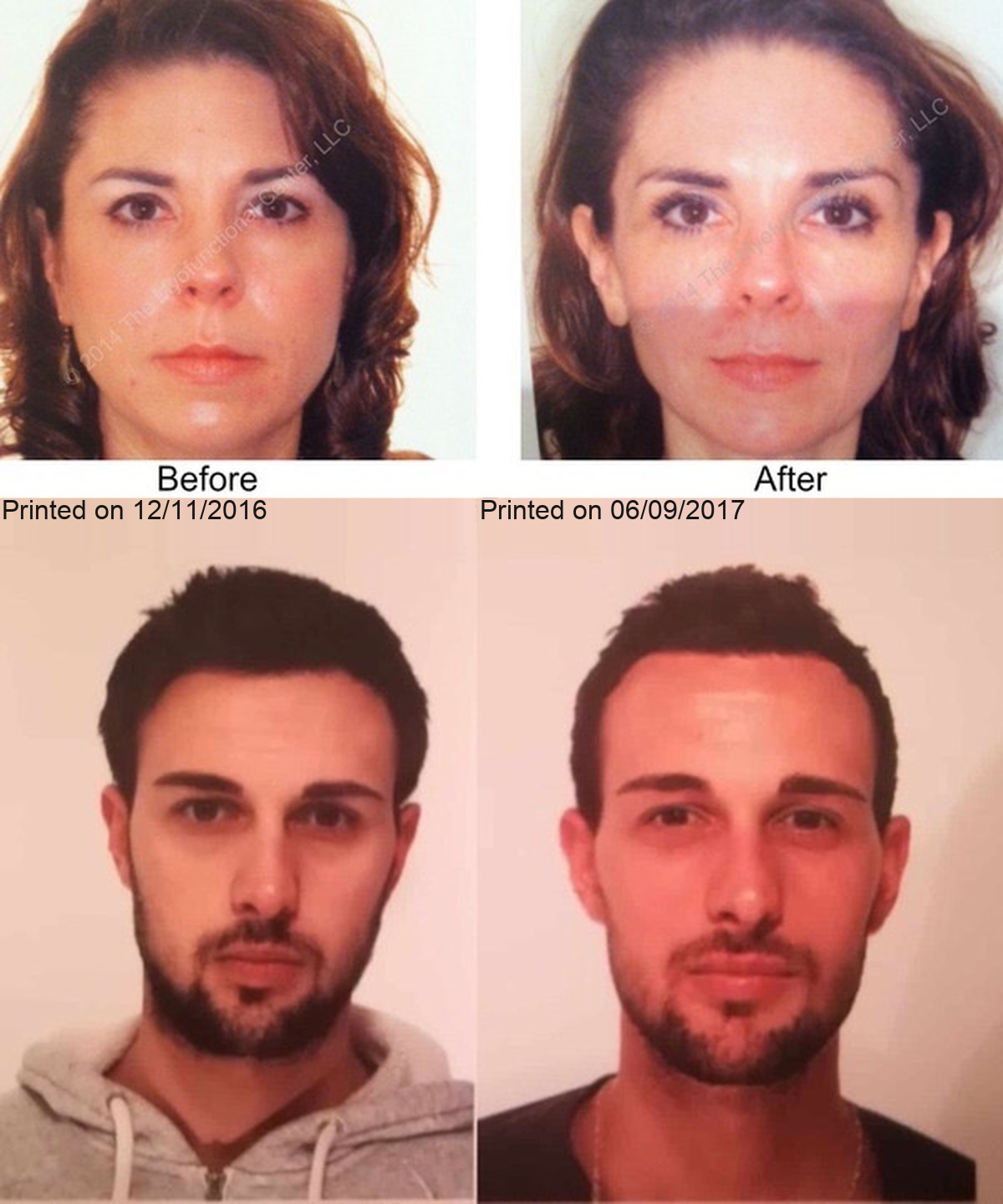
The secret of successful myofunctional exercises is initially to keep reminding yourself to place the tongue's tip in the hollow on the palate behind the front incisors (in the position of the Spanish letter ñ) and raise the tongue's base to the palate (calling in the strong friends who will help carry the sofa, the maxilla, upstairs). For beginners, the best way to learn is to make an excessively wide ‘cheesy’ smile in this tongue position with the teeth together (do not put pressure on them).
The next stage, once you are accustomed to the new sensation and aware of the new tongue position, is to try swallowing. At first you will feel something strange at the back of the throat. This is the back of your tongue rising to the ‘roof’, the palate. Now repeat and try to retain this tongue sensation; hold it in this position. Only the tongue muscles work: make sure there is no activity of the lips or cheeks! Only the Adam's apple moves during swallowing! For many people, this will initially feel quite uncomfortable, as if you were choking on your own tongue. But many of you train your muscles in the gym and experience uncomfortable sensations: the same happens with the tongue muscles, among the strongest in the body. How are they any worse than the rest of the body's muscles? They need training too! Whenever you forget the sensation of proper tongue posture, do this exercise to remind yourself. You can do it anytime, anywhere; nobody will notice.
As soon as you are comfortable with this exercise, move on to the next, more difficult stage: try drinking water in small sips with this tongue posture. And the culmination: try eating with the new tongue position, first liquid food and then swallowing solid food. Initially, devote five minutes a day to training one of your body's strongest muscles, for example after brushing your teeth. After a short time, it will become a habit, and eventually a reflex at the unconscious level, when your ‘internal autopilot’ will adopt the correct position even while you sleep. You can also work with children in a playful way to make it interesting, setting aside a predetermined time for this ‘game’. Children progress very quickly, literally in a few short weeks. Adults will have to practise a little longer, but after seven or eight months the result will, as the saying goes, be ‘written on the face’.

Wearing an intraoral ALF appliance also provides excellent training of proper tongue posture and the ‘adult’ swallowing process. As a light-wire construction that expands the upper jaw and eliminates cranial torsions, it does not take up the tongue's space. In addition, the tongue's tip finds the correct ‘support’ point itself in a special bend of the appliance. The Starecta splint is interesting in this respect too: although it balances the skull bones in a somewhat different direction, wearing it also ensures proper tongue posture and development of the ‘adult’ type of swallowing.
Many people wonder whether the myofunctional exercises above can be performed with temporomandibular joint dysfunction. The founder of the orthotropics method, Mike Mew, documented cases of complete recovery from TMD through mewing exercises. At the same time, the founder of orthocraniodontics in our country, A. O. Savinov, wrote on his forum that the possibility of performing such exercises depends on the individual case. Perhaps, in cases of facial pain, it is still better to refrain from myofunctional exercises.
Whatever approach you choose to training proper tongue posture, remember that the tongue muscles are the true driving force of the midface. The more we develop this force by increasing pressure on the upper palate, the more our upper jaw expands, forming a beautiful smile, and the higher and more three-dimensional our maxillae become, giving our face particular attractiveness. And finally: constant practice is the key to success!

Myofunctional correction: results — here.
Mewing exercises: how to ‘mew’ correctly — here.
___________________


120 comments
Ask a careful question or add useful context. New comments are reviewed before publication.