
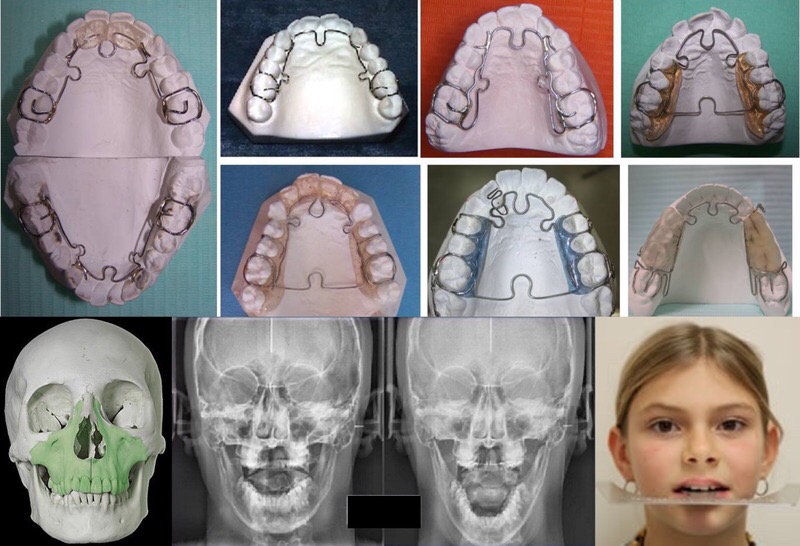
Today, more and more people seeking a beautiful smile are turning not to standard braces, after which many feel varying degrees of ill health and do not recognize the outline of their own face in the mirror, but to the new arrival ‘from overseas’, the ALF appliance. In this article we will find out what this marvel is, what advantages ALF has over braces, what principles it works on, and what effect it has on the whole body.
What is ALF orthodontics?

ALF (Advanced Lightwire Functionals) is an unconventional orthodontic treatment method using the light-wire ALF appliance. This method is based on the principles of cranial osteopathy and eliminates malocclusion at the level where its cause arises: disruption of the natural position of the cranial bones.
The ALF technique stimulates proper development of the facial skeleton and makes it possible to achieve attractive, harmonious facial aesthetics. Unlike conventional braces, ALF is a removable appliance. It is a custom-made wire structure. In each individual case, depending on the objectives of the orthodontic treatment, the ALF appliance can be made in a wide variety of shapes.
Advantages of the ALF appliance over braces

To move the jaws and teeth, the ALF appliance uses the osteopathic principle of ‘gentle force’, which means that the patient experiences considerably less discomfort than with conventional braces. The appliance's removable design allows more thorough attention to oral hygiene than fixed braces do. Moreover, ALF is practically invisible when worn, which cannot be said of braces. Treatment with the ALF appliance saves the patient considerable time, since visits to a specialist to adjust the appliance are needed only every 6–8 weeks. With ALF, there is also no problem of brackets coming unstuck, something patients undergoing treatment with braces often complain about.
As mentioned earlier, ALF promotes proper development of the facial and cranial bones, making the face symmetrical and balanced, lifting its middle part and rejuvenating it (more details — here). Not everyone likes the aesthetic result of braces, however, since in most cases the face becomes narrower and longer during treatment with them. Another advantage of the ALF appliance is that it helps enlarge the airways and improve posture.
How the ALF appliance works

As we have already learned, ALF orthodontics works on the principle of cranial osteopathy: a technique that gently acts on the skull bones (including the facial bones), fascia and meninges. By rearranging these structures, this technique is used to treat various dysfunctions and improves the patient's overall health. The main principle of osteopathy is that the body's proper structure leads to healthy function. The ALF appliance works on a similar principle, continuously exerting a gradual, gentle influence on the cranial structures and achieving similar results in their reorganization.
The ALF appliance itself was developed in the early 1980s by American researcher Darick Nordstrom, based on the concepts and design of the Crozat and Kernot orthodontic appliances. Dr George Crozat, after whom the first appliance was named, maintained that it could treat all types of malocclusion and ‘release stress through the teeth into the supporting structures, thereby producing tissue changes in them’. He called this process a ‘logical and natural influence’, in contrast to the ‘principles and methods used in systems where the teeth are locked and nature is raped’.
ALF's effect on the skull bones and the body as a whole

Patients can achieve excellent results with conventional braces if they are certain that their cranial structure has been stabilized. In healthy people, the skull bones are usually not locked and are in constant rhythmic motion, or, simply put, they ‘breathe’. The osteopathic term for this movement is craniosacral movement. In most people, however, the cranial sutures are locked to some degree, which is precisely why fitting braces without first stabilizing the cranial system can aggravate this process.
Factors causing locking in the skull's structure include accidents and head injuries; birth trauma, especially when forceps are used; incorrect dental treatment (wisdom-tooth extraction, inadequate filling height, incorrect crown placement, treatment with braces in which the jaws were displaced); loss of a tooth without adequate replacement, and so on.

The creator of the ALF appliance, Dr Darick Nordstrom, quickly realized while treating patients that they were beginning to be freed of other health problems that had initially seemed unrelated to their bite: allergies caused by restricted nasal breathing; bruxism; developmental delays, for example in children's learning because of reduced blood flow to the brain; digestive problems; ear problems (tinnitus, reduced hearing); headaches, including migraine; neck and back pain resulting from displaced vertebrae and pinched nerves; TMJ problems; vision problems; PMS, and so on.
Treatment with the ALF appliance can significantly improve the patient's health, since the ALF technique takes a holistic approach to the body. However, the effectiveness of treatment depends not so much on the appliance as on the knowledge and experience of the doctor using it. There are only a handful of truly top-level specialists of this kind in the world, and in our country this is Dr A. O. Savinov, with his innovative field of orthocraniodontics.
The maxilla: the bone of beauty, or all about the upper jaw — here.
Orthocraniodontics: philosophy and the basic treatment algorithm — here.
________________
The header collage above uses photographs from www.osstefanelli.com, tmjtherapycentre.com and new.drmaribelvann.com.


71 comments
Ask a careful question or add useful context. New comments are reviewed before publication.