
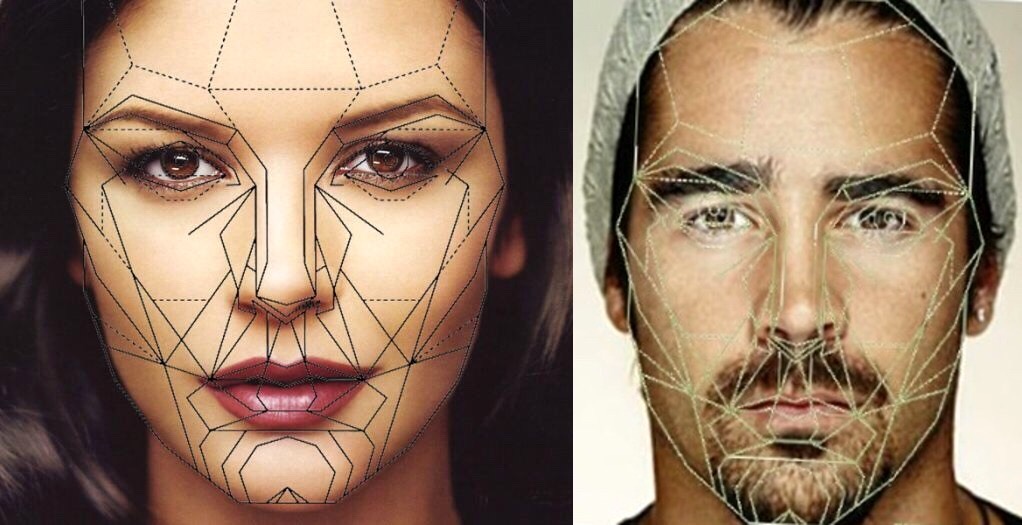
Beauty is mathematics. At least that is what the ancient Greeks believed as they extolled the beauty of the perfect human body. If this is true, there must be a mathematical code, a standard, a formula, or even a number with which beauty could be expressed. Historically, many numbers were tried in the attempt to describe it, but over thousands of years, only one mathematical relationship could be traced in the beauty of all peoples…
Is beauty really in the eye of the beholder?

It is believed that the concept of beauty depends on the era, race and prevailing culture in society. Moreover, we have all heard that 'beauty is in the eye of the beholder'. That sounds beautiful, but what about the fact that a person is born with an innate desire to look at beauty? The enormous influence of culture on the formation of a standard of beauty cannot be denied, but research in evolutionary psychology points to something else underlying our ideas of what is beautiful and what is not, regardless of race and time.
Scientists have repeatedly proved that people involuntarily perceive precisely symmetrical objects, bodies and faces as beautiful. Symmetry is what they involuntarily identify with attractiveness. Even small children look longer at the faces of symmetrical people. Moreover, proportional faces and bodies arouse unconscious admiration. Pythagoras, who linked beauty with mathematics, already noted that the objects perceived as most beautiful are those whose proportions conform to the golden ratio found in nature, art, architecture and the structure of the Universe.
The 'beauty mask' as a standard of Eternity

American oral and maxillofacial surgeon Stefan Marquardt studied human beauty in his practice for more than twenty years. He carried out cross-cultural research and analysed the human face from the dawn of civilisation to the present. Here, he discovered that beauty is linked to the golden ratio and can be defined for men and women of any race, era or culture. This is how his universal 'beauty mask' came into being, which specialists in many fields around the world now use in their work. At the heart of this reference 'mask' is a decagon, which embodies the golden ratio in all its dimensions.

To our great surprise, we can discover that this golden-ratio standard of beauty corresponds both to the faces of ancient Egyptian, Indian and Greek sculptures, and to those captured on the canvases of the greatest artists of all time—for example, da Vinci's mysterious Mona Lisa. The same standard corresponds to all the stars of the last century and today, from the delightful Marilyn Monroe and Grace Kelly to the expressive faces of Beyoncé, handsome Brad Pitt and 'the most beautiful Russian girl in the world', Kristina Pimenova.

Body symmetry: why it is so captivating, and how to achieve it—here.
________________


8 comments
Ask a careful question or add useful context. New comments are reviewed before publication.