
Anyone suffering from an illness or injury has surely wondered at least once whether they have bad karma, committed ‘sinful acts’ in a past life, ‘made a mess’ and are ‘now atoning’, or whether this is difficult ancestral karma. Of course, all these things exist, but it is not as simple as it may appear at first glance. Why that is, we will try to understand in this article. We will also discuss the inheritance called the human body, why we receive precisely this body from our lineage, and what practices a person can perform to harmonise their karma in order to heal from illness.
Karma and injury
Many are certain that karmic illnesses cannot be resolved. That is not so — at least, that is what wise people say. We will return to this a little later; for now, it is important to understand that illness resulting from karma and injury are completely different things. So:
Karmic illness is an ‘informational’ illness, embedded in a person's energetic structure as a distortion or contamination of that structure. A karmic illness cannot be avoided, since it is programmed into the person. It can be cured by acting specifically on the energetic structure, and the person can do this entirely independently (more on this below). Medicine is generally powerless against karmic illnesses.
Injury is physical damage to the body that only a doctor can cure. For example, if you have a broken arm, no prayers, mantras or other energetic practices will help until a surgeon comes to your aid. Physical injury affects a person's energetic structure. Most often, injury occurs through chance. There is a view that accidents and injuries do not just happen for no reason. Definitely. But not when they are inflicted intentionally — sometimes on the scale of a country or entire state systems…
A little about conspiracy theories
The modern obstetric system, as well as non-physiological childbirth lying down, leads to catastrophic consequences for a child's skull. Before the spread of the Roman Church's influence and its medieval ‘witch hunt’, childbirth was upright in all ancient communities. But where nature had previously ruled, and experienced midwives attending births considered the process natural, the Church began to intervene. It went so far that women were forbidden to use natural pain-relieving herbs because ‘a woman must give birth in agony’. A little later, ‘to help’ women, state medicine offered ‘scientific’ obstetric forceps, turning the woman giving birth from an active participant into a passive, recumbent patient. And this has been happening for the last three hundred years.
In the Soviet Union, an obstetric technique damaging the infant's cervical spine was introduced in the 1950s. The crippling consequences for a person's physical and psychological health can be seen in the article about the first cervical vertebra, the atlas. It is worth asking why, and by whom, such deforming action on the human structure takes place on this scale. After all, it is known that physical injury affects a person's energetic potential and psychological status.
The ‘worldwide epidemic’ of braces ‘magnificently’ ‘finishes off’ the cranial deformities received at birth, with damage from braces sometimes causing consequences akin to traumatic brain injury, quite apart from their deforming effect on the spine, one of a person's most important energetic structures. In some European countries, research programmes for the intraoral ALF appliance, which eliminates cranial deformities, are being curtailed at state level. Of course, it is understandable that braces are simply much more profitable for corporations and less difficult for doctors to learn than a holistic approach to the body. But perhaps there is something else behind this? And would such intentional damage to a person's structure, and withholding information about it, be considered ‘caused by their bad karma’?
The body as the lineage's testament
It is believed that every person born initially carries the potential of the Image of God. But it is not given simply by the fact of birth: perhaps a person's energetic structure is significantly damaged by outside intervention during birth itself, as discussed above. Yet it is equally true that the original Image of God within a person is distorted by the lives of many previous generations of their lineage, producing bez-obraznost — a loss of the image. From this perspective, illness and distortion arise when an ancestor, through unworthy acts and thoughts, separated themselves from unity with Universal Wholeness. These structural distortions can be corrected if a person restores the ‘current’ of interconnection and circulation with that Wholeness. To do this, they will literally have to cleanse their structure of ‘contamination’ and, like an archaeologist, descend into ‘internal excavations’ of themselves.
As is known, children pay for the unworked karma of their parents and ancestors to the seventh generation. But this will be less surprising if one sees how a person's preceding generations form the genetic structure of their body, into which, as into a carrier, all information about the lineage's vices and virtues is recorded. For example, a person's pelvis is the person themselves; the right and left femurs are their father and mother; the two bones of each lower leg are the paternal and maternal grandmothers and grandfathers; the increasing number of bones in the feet, ‘then going into the earth’, are the great-grandfathers and great-grandmothers, and so on. (It is not for nothing that the degree of kinship from parents to children is called a koleno, or ‘knee’, of the lineage — hence the Russian word pokolenie, ‘generation’.) The upper body mirrors the lower according to the principle ‘as below, so above’. The left and right halves of the body are the female and male lines of the lineage. And it is precisely the preceding generations that pass on all illnesses and distortions of a person's body and life (again, unless it was an intentional injury). To heal one's lineage, it is important to pray for the redemption of one's ancestors, and thus of oneself and subsequent generations. One healer told me that ancestors often sit ‘on the other side like hens on a perch’, waiting for someone to come into the lineage who will pray for their redemption.
Ancestral practices
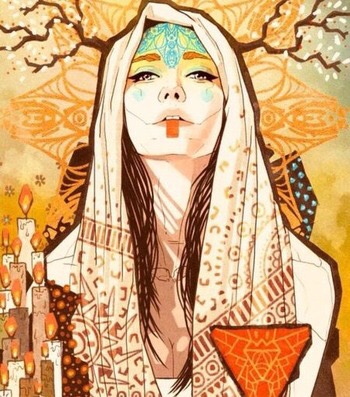
Many people beginning ancestral practices protest: ‘Why do I now have to clear up someone else's sins?’ The first important thing to understand is that a person's soul does not come into its lineage for no reason: certain karmic knots bind it to that lineage, which it can finally untie. Still more important is understanding not what you are doing, but why. It is important not to approach praying for members of your lineage as cleaning away dirt or something sinful. That is not why you perform the prayer recitation. You do it to heal your lineage and restore the flow of Love within it, from the elders to the younger members.
This is very important, because during such recitations a person often feels like a ‘beacon’ who has come into the lineage to cleanse it — a kind of Jesus Christ. Thinking this way is a major mistake: with such an attitude, the person may simply take responsibility for their lineage members' wrongdoings upon themselves, and such ‘karma cleansing’ will lead to nothing good (you can imagine all the possible consequences if you take such a burden onto your shoulders). Therefore, it is important to approach the recitations specifically as a younger member of the lineage, respecting the elders and leaving them full responsibility for what they have done (otherwise it is pride). Meanwhile, you hope for the mercy of Higher Powers (the Universe, God) in forgiving what was done. You are, as it were, lovingly forwarding a petition for someone to the Highest Authorities, where it is decided what to forgive and to whom.
Before beginning the practice, it is important to ask your lineage's blessing for it. To do this, you can place a hand over your heart and mentally address your ancestors. The second important point is to set a specific intention as to why you are doing the practice: first the general one (restoring the flow of Love in the lineage), and then a specific one — for example, that healing from illness may come, that the soul may feel at ease, that the heart may fill with joy, and so on. But you can ask for all this only from a position of unconditional acceptance, without judging any of your ancestors' actions, leaving them full responsibility for them, from the position ‘I am the younger one; you are the elders’, and with hope in Higher Wisdom. Now, from this state, you can begin reading sacred scriptures (mantras).

Christians can recite the Psalter of the Mother of God for the female line of their lineage (first), then the Psalter of David for the male line (or that of Ephrem the Syrian, which is easier). These must be recited 21 times (preferably 40), without skipping days. That is, once you begin reading, you do not take days off and read at least one kathisma each day, even if you feel unwell — a very frequent accompaniment of such recitations. You may feel physically ill, illnesses may flare up, you may be emotionally ‘shaken up’, some working-through of issues with other people may begin, you may lose something, a child may become ill, and so on. You need to know these things and not think that these recitations come easily.
Another very important point: after asking your lineage's blessing for the recitation, with a request for protection and guidance, you can read your intention and request to God before reading the Psalter. It might sound approximately like this: God Almighty, forgive me and my lineage all sins, destructive programmes, attachments and emotions through which my lineage and I received all destructive connections, all illnesses, all ancestral curses, hexes, all frights, fears, stresses, all karmic debts and all negative ancestral programmes. Give me understanding and awareness of these sins, attachments and emotions of mine and my lineage, and eliminate in me and in my lineage… /repeat from destructive connections/. After each recitation, give thanks in the same order: for forgiveness, for being given understanding and awareness, and for the removal from your lineage of what you ask. Do this with love.
You can also read any sacred scripture of your faith. For Hindus, the Bhagavad Gita is suitable (to read it correctly in Sanskrit, you can find its songs online, download them onto your phone and simply sing along, following the text). One of the strongest mantras, including for ancestral recitation, is Shiva's death-conquering mantra, the Mahamrityunjaya (you can find a recording on YouTube that feels closest to you). Why is this particular mantra used for ancestral recitation? It heals the energetic body at the DNA level, and that is precisely where all the ancestors' distorting programmes are recorded. For ancestral recitation, this mantra must be read (or listened to while singing along) 108 times a day for 40 days, but in reality few people endure this (people really become very unwell for the reasons discussed above). The mantra is very powerful, so, to avoid driving yourself too hard, allow time for recovery and still not interrupt the practice, it is better to read it 21 times a day for seven months (you can calculate the precise number of days by multiplying 108 by 40 and dividing by days).
Two other effective ancestral practices are offering rice to the ancestors and donations of time, food or money on behalf of the lineage. For very weakened people and those exhausted by illness, perhaps only the last practice is suitable, since these practices are very powerful, consume much energy, and in many cases are quite difficult even for healthy people. People who have suffered an injury, especially to the neck or head, are better off completely avoiding the practices described above, except donation. The point is that these practices produce strong changes in the energetic body, while physical injury to the higher centres may severely block this process and the person may literally begin to be ‘torn apart’. In this case, the practices above will only painfully draw energy out of the body, whereas a person with an injury needs, on the contrary, to become rooted in it as strongly as possible. Here, perhaps the most effective thing will simply be prayer and praying to be granted a healing method or a doctor.
Praying to be granted a doctor
While translating materials on biomechanical treatments, I noticed that almost everyone who had been cured had prayed for healing. For example, Starecta founder Moreno Conte, in a dreadful state, followed Buddhist teachings, meditated a great deal and simply prayed, as he describes in his book: ‘Sometimes I crawled into a corner, prayed there and cried. Often, alone, I went to the seashore and appealed to the Lord for help — yes, it was me, who had never believed in anything before. I resisted, repeating again and again that it was all ridiculous, but when painful pride steps aside, you begin to believe in magic and something greater than yourself.’ In the end, he not only cured himself but has already helped thousands of people worldwide. Interestingly, one of his followers, footballer Simone Sincini, made a pilgrimage to a well-known Catholic shrine in Bosnia and Herzegovina before learning about this method and then being cured.
I know for certain that many people make such pilgrimages and pray for healing (sometimes for years) before meeting their doctor. For example, one of the most effective practices in this respect is reading the akathist and prayer to the renowned surgeon Saint Luke of Crimea. His relics are also in Simferopol, and people really do tell of miracles after appealing to him for help. A woman I personally know prayed there for a successful outcome to her husband's operation, although there was little hope; both the operation and recovery went as favourably as possible. One can address one's prayer to any saint one feels drawn to. Another interesting case happened to a man I know: he was reciting mantras to the Hindu deity Ayyappa, and his father had a serious health problem at the time. A surgeon ‘happened’ to appear and performed a very successful operation on his father. This doctor's surname was… Ayapov. I am serious.
Metropolitan Anthony said that the human body is like a surgical glove, the most fragile thing one can imagine, yet it can work miracles if an experienced hand acts through it; likewise, the actions of the right doctor are filled and guided by God's power. I remember an episode of ‘House’ in which a nun was brought to him near death, having visions in which she saw Christ. Dr House simply discovered an intrauterine device in her body, fitted back in the sixties, which was poisoning her entire body with toxic metal and causing severe hallucinations. A convinced atheist, House asked: ‘So who won — me or God?’ The nun answered: ‘I prayed a great deal, and God brought me to you.’ You must agree, there is something in that…
Is it crime and punishment?
For some reason, people who become ill and suffer from it often perceive illness as punishment for sins (their own or their lineage's). First, healers often say these are not sins for which one must now punish oneself and suffer, but wrongdoings that can be prayed away and atoned for (including through donations of time, food or money). A grave crime or unfair treatment and actions need not necessarily have occurred. Often, they may have been angry words spoken ‘in the heat of the moment’, negative thoughts, or even curses, mental or spoken aloud, fuelled by a strong emotional charge. One can try to correct all this, eliminate distortions of the energetic structure and restore the flow of Love in the lineage.
Second, illness may also be an unexperienced event from a past life ‘recorded’ in the body's memory. For example, Stanislav Grof, known as the founder of holotropic breathwork (and, incidentally, a deeply religious person who accepts all religions), describes cases in his books such as a man whose stomach hurt all his life and who, during a session, had a vision of himself as a knight in armour being killed by a sword in the solar plexus region. After experiencing extremely intense bodily sensations in this area during the session, he spontaneously healed in real life too. Similar cases involving the heart are described in holotropic breathwork sessions. Perhaps many ‘head’ and ‘neck’ problems may also result from such phenomena, when a dying person did not have time to realise what was happening: a bullet in the back of the head or temple, hanging or beheading, for example (incidentally, one should not venture into holotropic breathwork with these). All this is a mystery, and perhaps we cannot know it reliably. But it is definitely not ‘punishment’ for some ‘grave crime’. For some reason, things are arranged this way.
Third, many healers say that sometimes illness or injury may indeed be given to a person as something for their own or ancestral wrongdoings that must be prayed away or atoned for. Sometimes, however, it is so that the person moves to a new level of development. Then they have to take not merely a step backwards but ten-mile strides downwards, from where they must find their way out themselves, without hints. It also often happens that a certain potential and developmental programme are embedded in a person; if they do not realise it, the potential's energy becomes blocked inside, and they become ill. Incidentally, this often manifests in descendants of healers when someone in their lineage refused this gift.
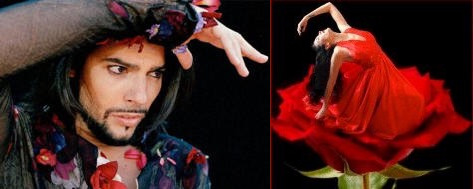
In any case, according to healers, illness is something that helps a person develop, like a ‘packed’ programme inside them, which is often difficult and painful to ‘unpack’, but ultimately the person receives gifts and blessings they could not previously have dreamed of. In Spain, there is a concept called duende. It implies soul, fire and feeling. In Russian, one says ‘There is no fire in him’; in Spain, ‘No tiene duende’. It is impossible to comprehend its power without going through difficult inner trials. The famous Spanish poet García Lorca said this about duende: ‘It is a demonic force with which one must enter into combat and prevail: it sweeps away cosy, memorised geometry; its approach heralds the breaking of everything familiar. But it is also dawn, unprecedented, unimaginable freshness — duende, like a rose in bloom, like a miracle.’
____________________
2 comments
Ask a careful question or add useful context. New comments are reviewed before publication.