
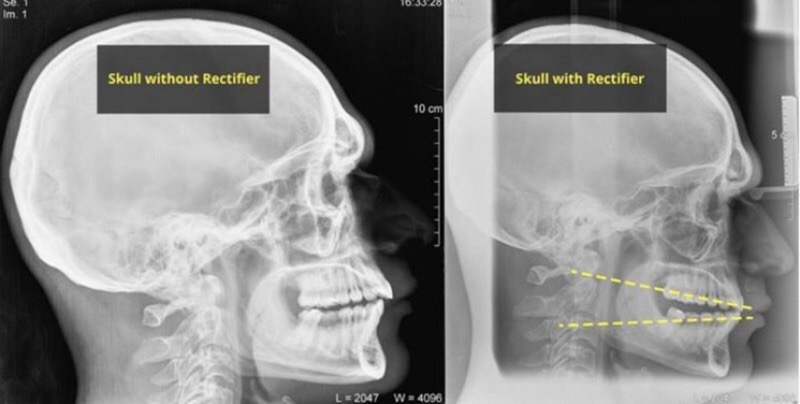

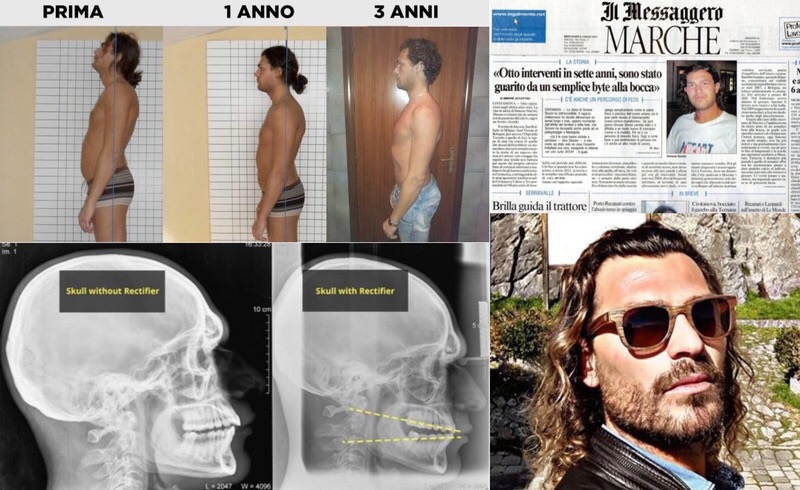
The Rectifier is the fundamental tool of the experimental Starecta method for treating spinal deformities and a number of other symptoms associated with these conditions. This intraoral device is the result of research by the Italian Moreno Conte, who intuitively developed this technology out of desperation: the twisting collapse of his skeletal structure brought him almost to death, and he needed to find a way to survive. He succeeded. The intraoral Rectifier device, which Moreno tested on himself and thousands of patients around the world have already tried, creates orthopaedic forces capable of changing the skeletal structure, restoring its upright position and symmetry and rebalancing all the structures supporting the skull.
Radiographic confirmation
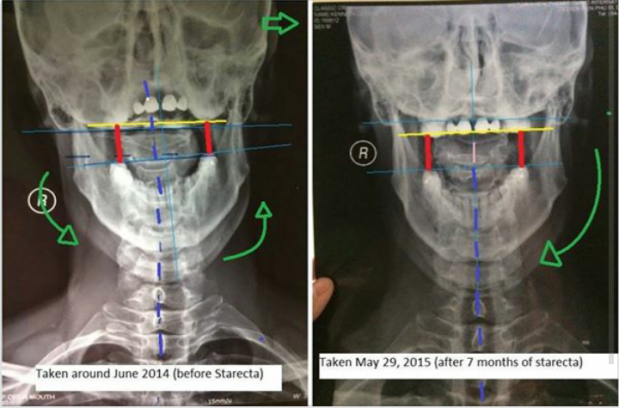
The X-rays above show how seven months of using the Rectifier can change the bony structure supporting the skull: the jaws, dental arches, facial bones and cervical vertebrae. This patient suffered from chronic pain in the neck, left shoulder and back, voice problems (‘broken voice’), chronic fatigue syndrome and neurological problems, including difficulty concentrating. Seven months of treatment resolved these symptoms. Before turning to the Starecta method, this patient tried many treatments in both conventional and alternative medicine without improvement (his detailed story is here).
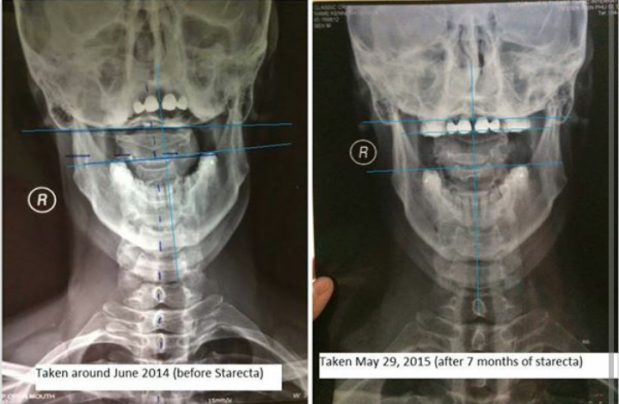
In the next image, you can see a schematic model of the change in his skeletal structure.
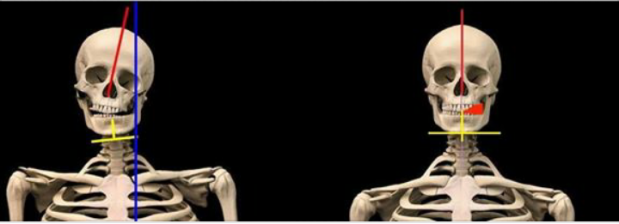
How the Rectifier works
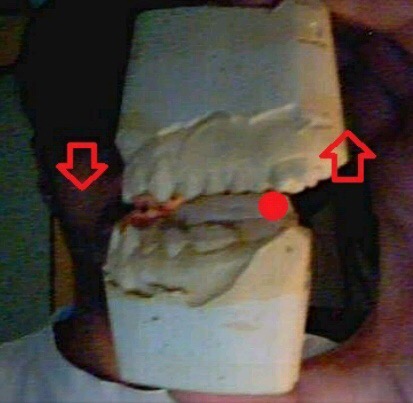
The Rectifier is a gradually adapting, dynamic dental splint for the lower jaw whose position needs to be updated every two weeks. This dental splint produces orthopaedic forces by using the swallowing reflex to activate a lever located on the molars: the three large back teeth on both sides at the rear of the jaw. The resulting orthopaedic forces push the lower jaw backwards (which is why the lower jaw must continually be moved slightly forwards when activating the splint), raise the facial bones and push the skull upwards. The Rectifier must be used twenty-four hours a day and, most importantly, during sleep at night.
A gradually adaptable device
The splint is adjusted every two weeks directly in the mouth. The patient must sit on a chair or stand upright, trying to stretch the spine and neck as much as possible while holding the mouth open. This position can be imagined as an attempt to move the crown of the head as far away from the pelvis as is possible at that moment. In this position, the new bite is registered on the splint until the Rectifier's material hardens while the person is still sitting (or standing, if they are registering it while standing).
Rectifier: step-by-step instructions — here.
Orthopaedic forces
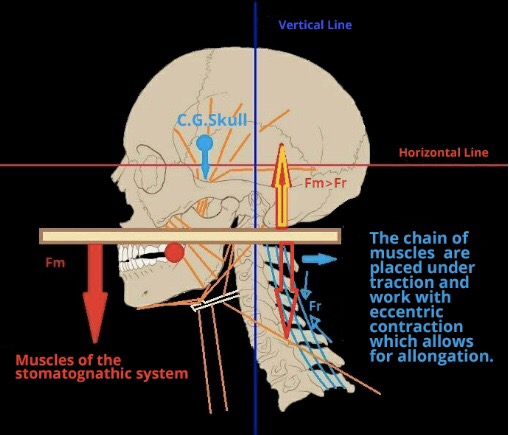
As already stated, the Rectifier uses orthopaedic forces produced by swallowing to activate the lever located on the molars at the back of the jaw. The image above helps explain this principle. The Rectifier device raises the skull only in the molar and premolar region (the three molars and the two premolars preceding them on the dental arches). The Rectifier effectively shifts the lever's fulcrum distally (towards the back of the mouth) and uses the skull's weight and the lower jaw's movement during swallowing to create a force that raises the skull and restructures the position of the cervical vertebrae. The next two photographs below show how the molar lever works.
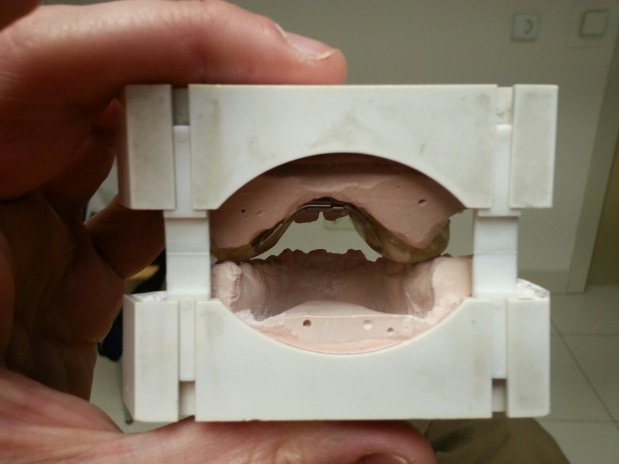
By applying force with your hand in the same direction as the chewing muscles (the red arrows in the picture below), you can clearly visualise how the back of the mouth is subjected to a stretching force (the green arrows in the illustration): the white plastic holders move upwards along their base, and the distance between the lower and upper jaws at the back of the mouth increases by approximately half a centimetre.
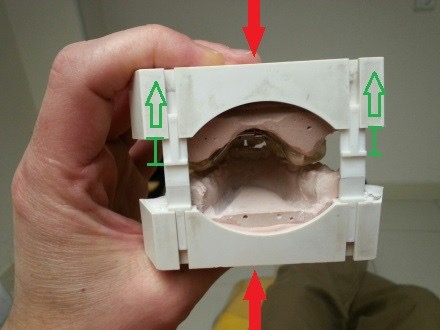
Thus, the lever located in the molar region of the dental arches stretches the back of the cervical spine and raises the skull.
The Rectifier for eliminating spinal deformities
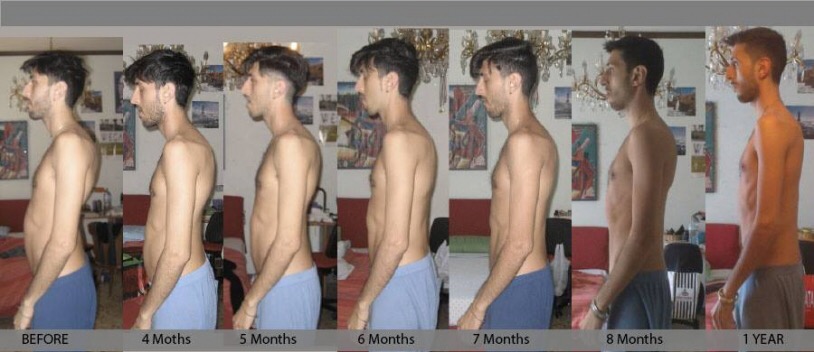

The Starecta method has scientifically confirmed and documented evidence of eliminating morphological deformities of the twisted spine known as scoliosis, hyperlordosis and hyperkyphosis. The Starecta method is based on the principles of Newtonian mechanics applied to the human body, which this method considers a musculoskeletal biomechanical system. Using the lever method, the Rectifier restores correct posture to the body, allowing the spine to stretch in an entirely natural way.
Condylar-shaped teeth
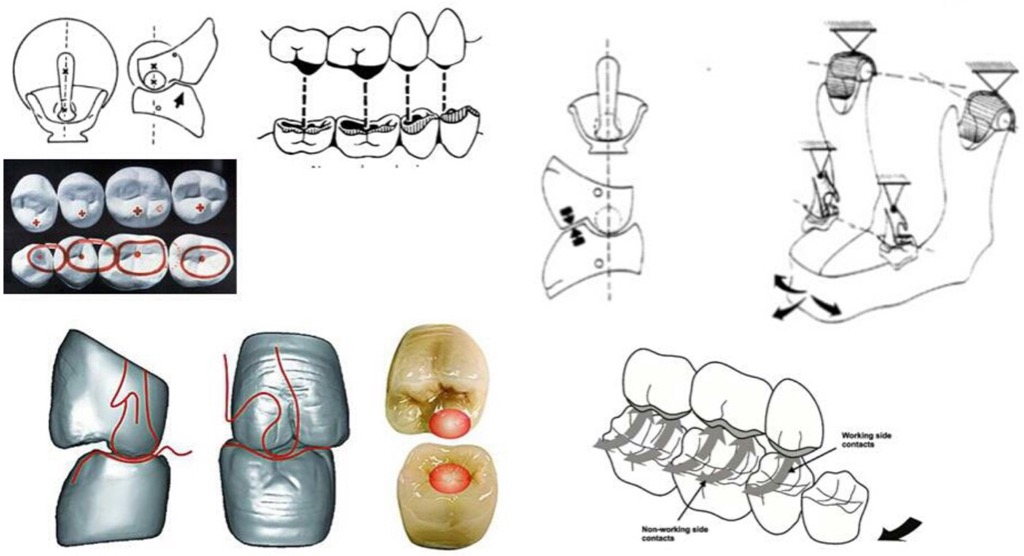

The Rectifier reproduces in the mouth what is technically called ‘Gerber's bilateral balanced occlusion with condylar-shaped teeth’ (according to his condylar theory, Gerber developed condylar-shaped teeth whose chewing surfaces are shaped so that each pair of opposing teeth represents a mini-segment, with the fissure of the lower tooth forming a pronounced chewing groove and the corresponding upper molar forming a pronounced palatal cusp). The illustration above shows schematically how this works.
The Rectifier creates the shape and curvature of a chewing groove in the lower molars and palatal cusps (the so-called condyles) in the upper ones. Thus, the lower jaw moves along the curves of the molars, imitating the movements of the condyles (the ball-shaped ends) in the joint socket. The next image clearly shows how, in accordance with the ‘Bennett movement’ (an orthopaedic concept), the Rectifier allows the axis of the occlusal plane to align with the axis of the cervical spine.
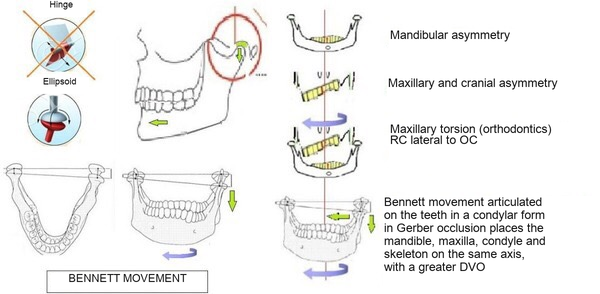
It is worth considering that this concept is the complete opposite of the currently widespread occlusal concepts based on the centric relation of occlusion and the principle of ‘anterior guidance’ (the principles of orthocraniodontics are similar to Starecta in this respect). With the Rectifier, molars on opposing dental arches work in a unified articulating movement (which describes curves), with forces between opposing teeth in different directions. In the widespread ‘anterior guidance’ philosophy of occlusion, however, teeth have only vertical forces at their contacts.
Technical information about Starecta. Very important! — here.
How to make a splint for biomechanical treatment yourself — here.
_________________
The original article is on https://biomechanical-dystonia.net; Russian translation

69 comments
Ask a careful question or add useful context. New comments are reviewed before publication.
Seriously speaking, the creators of the method write that a splint cannot be used if two teeth in a row are missing; if only one is missing, it can. Otherwise, the missing tooth would first have to be replaced with an implant.
Craniodontics: the best specialists
If the teeth are covered with crowns, can the Rectifier Starecta splint be used?
The current device is available through the Jaw & Body shop:
Starecta Rectifier
Please read the product information carefully before considering it.
Facial asymmetry: how to correct it with the Starecta method (available later)
You can order the device on the official website in Italy, the current shop (the red “buy now” text at the top), but don’t rush to do that, because a free test campaign may possibly launch locally. Check the blog’s homepage on Fridays, when a new article comes out. If such a campaign really happens, I’ll immediately write an article about it with the details. For now, I’m keeping an eye on how things develop.
But also consider seeing an orthocraniodontic specialist, because they work with the skull in three planes, while the Rectifier only works in two, and in some cases that is not enough.
I’ve collected a list of specialists here:
Craniodontics: the best specialists
If, along with spinal alignment, you would also like to improve the aesthetics of your bite, then it is better to consult specialists about this, for example orthocraniodontists (Orthocraniodontics: philosophy and the basic treatment algorithm) or specialists in the BOS/OSB method (Dental occlusion and body balance treatment method (available later)).
other websites? And making it myself out of polymorph without a mouthguard is kind of difficult, honestly it’s probably not working at all?
This topic is covered in a later archive article: The old and new Rectifier splints: what are the differences? (available later)
Jaw & Body shop offer:
Starecta Rectifier — Starecta Rectifier
Body Balancer — Body Balancer
Descriptions, current prices and ordering are on the product pages.
Please note that the splint in its convenient old version can be made completely on your own using the method of the Spaniard Marcello Massa:
How to make a splint for biomechanical treatment yourself (available later)
I wanted to ask a question. I have obvious facial asymmetry: the right side of my jaw is slightly lower than the left, and unlike the left side it is not defined at all. The same goes for my right eye. The whole right side of my face seems narrower than the left and looks slightly swollen. I’d like to know whether this method could help in my situation. Of course, I’m planning to see a maxillofacial surgeon first, but I’m afraid they’ll only offer me braces together with surgery.
If you see a maxillofacial surgeon, then of course he won’t be able to offer anything except surgery.
Judging by your description, you have a combination of several cranial strains, and Starecta has limited effect in this case. Next month I’m planning to write a detailed article about these kinds of cranial deformities, so if you’re interested, you can check back.
So in your case I would go straight to a competent craniodontist. You’ve probably already read what orthocraniodontics is, but I’ll leave the link just in case:
Orthocraniodontics: philosophy and the basic treatment algorithm
I’m collecting a list of such specialists here:
Craniodontics: the best specialists
I hope this information helps you. But the decision is yours alone.
I can see that I have a “hump” at the base of my neck, which I’m trying to fight, and I slouch if I forget about my back and relax. Of course I try to “hold” it, but I don’t understand whether this is within the normal range or not.
How to make a mouthguard/Gelb splint yourself (available later)
I’m off to order it and start molding.
And you don’t happen to know whether this Rectifier can be worn alternately with an orthodontic splint, do you? Maybe someone has tried it?
I didn’t understand what 6 oz means. Just in case, so that nothing sticks anywhere, get it from Amazon. I personally have that one, so I know for sure the product is good quality; it is even used for making temporary teeth. It has 170 grams.
How to make a splint for biomechanical treatment yourself (available later)
I’m asking because my osteopath talked me out of getting ceramic overlays to correct the tilt of my jaw, explaining that since I don’t have pain in addition to the aesthetic issue and my body is successfully compensating for the problem on its own, I shouldn’t try to straighten it, because there are no guarantees that pain won’t appear in the joint later.
Thank you in advance.
How can I explain it better? If the jaw is in the wrong position (for example, there is not enough bite height on one side, or in the back part of the jaw), then session after session the osteopath will be reinforcing the existing cranial distortions. I have been through this myself and I know what I am talking about (I am planning to write an article about this next month).
At the same time, ceramic overlays “to correct the jaw position” are not a solution either, because our system is dynamic, and throughout the entire process of posture correction the occlusal plane needs constant adjustment (you can read the article “Why do I need Starecta if I can just have a dentist build up the height of my teeth right away?” Why Do I Need Starecta If a Dentist Can Increase My Tooth Height Straight Away? (available later) — everything is described there in detail).
The body really does compensate for this problem quite successfully, but then it turns out that an osteopath is not needed either, so as not to “help” the body “jump off” its “well-worn tracks.” And many of our “TMJ people” have this kind of experience (manual therapy when the jaw is in the wrong position, by the way, is basically a disaster; compared with osteopathy, the effect is immediate).
You can use the experience of people who have already been through this, or not. You can try to go through all of it yourself, all the way to the bottom. In any case, the decision about whether you should see an osteopath with an altered jaw position must be yours alone.
As for treatment with the Rectifier, here the effect is at the level of the bone structure, much deeper than osteopathic treatment. At the same time, an osteopath is indispensable during this kind of treatment, because they allow the body to recover more deeply and help relieve the inevitable spasms and unpleasant sensations that can occur when all the structures are shifting.
In any case, you can try it — you do not necessarily have to buy a splint; you can make one yourself inexpensively (maybe you have already read this article: How to make a splint for biomechanical treatment yourself (available later)).
As for what happens to the whole body structure during this kind of biomechanical treatment, you can read this:
What happens during treatment with orthocraniodontics and the Starecta method (available later)
I wish you good health, and I hope all this information will help you make up your mind and make the right decision in your case. Sometimes, if nothing is bothering you, it is better not to touch anything.
So, do I understand correctly that when the jaw is in the wrong position, osteopathic sessions only adapt the other bones to this incorrect position (without correcting the root cause in any way)?
Thank you!
Still, in my opinion, in the case of dislocation of the jaw joints, it is better to go straight to a specialist who understands the biomechanics of the skull.
Just in case, I will leave the list from the blog here:
Craniodontics: the best specialists
And also a link to the discussion section here, where we are trying to collect reviews of such specialists:
You can find related materials in this archive.
Keep in mind that you can also make one yourself, and we have a lot of feedback saying that this kind of splint is more comfortable:
How to make a mouthguard/Gelb splint yourself (available later)
And braces in some hands can work wonders; in other hands — forgive me, I will not write it out.
And craniodontists also make sure there is adequate support for the temporomandibular joints.
Of course, there can be adaptation, but in this case it is difficult to tell whether this is the movement of the skull bones as they are being aligned into the proper structure, or the opposite.
That is the situation, Lucy. I hope you make the right decision about what to do, because I simply do not have the right to advise you to stop treatment with your orthodontist and go to a craniodontist. I also do not know the level of the specialists you consulted before.
Starecta and mewing: how to reconcile conflicting forces (available later)
And that is why in some cases of lateral displacement of the cranial bones, it is also necessary either to add mewing or to go straight to a specialist who works with all three planes of the skull. We have a more detailed article about cranial distortions, with photo examples, here:
Skull distortions and bite (available later)
This topic is new to me, and I am still having a hard time getting into it) so for now I only find the information I need on the site with your hints) To be honest, my search for ways to correct spinal scoliosis led me here, so first of all the important information for me is whether it is possible to level both jaws with a splint in the horizontal plane. And judging by the information I have managed to study with your help, I also have lateral rotation with twisting, but since there do not seem to be any craniodontists in our city) reality suggests that I will have to do most of the work myself, and at best travel to a specialist already at the final stage of correcting my skull)
But also keep in mind that when correcting scoliosis, all three planes of our body must be taken into account (if cranial distortions occur in a 3D system, then all of them later descend through the whole body). That is why it is desirable to combine the Starecta splint with mewing — it is a very powerful tool. You have probably already read Emily’s story through the link, and the changes even with mewing alone are enormous. But now he has also added wearing a leveling overlay on the lower side.
By the way, just in case, I will leave you a link on making a splint yourself, which is much more comfortable than the purchased one:
How to make a mouthguard/Gelb splint yourself (available later)
If you have any more questions, write! I will be glad to help.
One side of my face is slightly lower than the other.
Starecta and mewing: how to reconcile conflicting forces (available later)
You can also follow my archive notes; there will soon be a detailed post there specifically about facial asymmetry:
You can find related materials in this archive.
This may be useful to someone: on the current shop the price of the Rectifier has been temporarily reduced, $49 instead of $199.
Jeffrey Brown (USA): “Dr. Good” (interview) (available later)
I do not work with this myself. Good luck!