

Official medicine doesn’t have an explanation of the reasons for the common ailment nowadays called hypochondria. These patients, harassing general practitioners with their numerous complaints, end up in the office of a psychotherapist or psychiatrist and, stuffed with psychoactive drugs, resign themselves to the fact that they are “easily suggested psychotic personalities”, “unwilling to take responsibility for their lives”. Or maybe it is the generally accepted scientific point of view that prevents them from doing this? In search of the real causes of hypochondria, we will turn to ancient wisdom and ultra-modern discoveries, and at the same time we will find out if a hypochondriac can still be cured.
What is considered hypochondria in modern medicine

Hypochondria is a disorder in which a person is overly concerned about the state of his health and it seems to him that he has a serious illness in the absence of objective reasons. At least that’s how hypochondria is described in modern textbooks on psychology and psychiatry. A hypochondriac is a person who constantly feels a painful condition, and who finds more and more symptoms of diseases in various places of the body – in the heart, gastrointestinal tract, genitourinary system, immune system, in the head, joints; he thinks he has some kind of exotic infection or autoimmune disease…
This description, perhaps, can be completed, adding only that modern medicine claims that hypochondria is not cured, “because it is not a disease of the body,” and “all the time running around the doctors” hypochondriacs are sent to psychotherapists and psychiatrists. But in practice it turns out that psychiatrists and psychologists are also unable to help these “imaginary patients”. It turns out a vicious circle in which a suffering person seriously begins to consider himself a psycho. Or maybe the point is not at all in the psyche?
What is hypochondria really

Interestingly, the term hypochondria itself comes from the Greek word ὑποχόνδρια, in which the suffix ὑπο means “under”, and χόνδριος – “the area of the body under the cartilaginous ribs”. It turns out that even in antiquity, the Greeks knew this disease, which for some reason was considered to be located in the area of the diaphragm (in modern terms). Did the ancient Greeks really not understand the problem at all and called this disease “located under the cartilaginous ribs” just like that? Let’s see what is in this area:
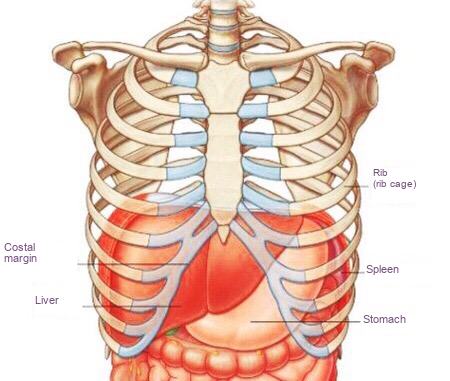
We see that under the lower edge of the ribs are the liver, stomach, spleen, plus under the liver we see the gallbladder slightly indicated in green. But in itself all this does not tell us anything. Let’s try to look at this picture a little wider. Then we can see that the internal organs do not “hang in the air”, but are supported by the diaphragm and a system of internal muscles, generously supplied with nerves that connect to the internal organs. At the same time, it is clear that each nerve is part of the unified nervous system of the body. Now let’s imagine for a moment that the ribs are compressed for some reason. What happens when this happens? All of the above internal organs and internal muscles, including nerve endings, are in compression.
Now imagine that you pinch your finger, for example, the smallest one is the little finger. Naturally, your nervous system will signal pain and your entire body will suffer until you release the pinching. But now imagine that you have not a little finger in compression, but vital internal organs… And this does not last for minutes, as in the case of a pinched finger, but for years (!) Plus, for a complete picture, imagine that the ribs are not just compressed, but, as it happens, turned to one side, and also tilted. It is scary to imagine what happens in this case with the internal organs, pierced with nerve endings. At the same time, when you pinch your finger and express concern about it, no one would even think of sending you to a psychotherapist about this, but you are sent there in case of compression of internal organs (sometimes very serious). This is not happening because doctors are “illiterate” – simply, alas, it is no longer in their competence. This injury belongs to the field of bodily biomechanics.
Why does rib compression occur?

Consider the ribs as part of a single human skeletal system. The figure shows the four stages of development of scoliosis in the frontal plane. Below we can see the first and last stages of the development of lordosis and kyphosis in the lateral plane. Imagine both planes in these pictures on top of each other and imagine what happens to the ribs and the internal organs and nerves below them.

You can read more about the developmental phases of all these spinal distortions and the live experience of a real person with such compression here. But now we are interested in the mechanism for triggering these changes, in which part of the body it originates and, most importantly, in what ways the situation can be corrected. This is important because the “imaginary patients” tired of real suffering have probably tried dozens of treatments from swimming and massages to chiropractors, physiotherapy and acupuncture, not to mention psychotherapists, but none of this helped them.
To do this, imagine that we are at the foot of a mountain and are trying to study it from this point of view – we consider separately stones, trees, paths (as many doctors of different specialties did before, to which the hypochondriac had already turned). And now let’s imagine that we have risen at a certain height above the mountain, and consider it from this perspective in integrity – after all, this is exactly what our body is.
Where is the “root of hypochondria”

The link above is the story of an Italian guy in postural collapse in third stage. He suffered from a variety of symptoms, including severe gastrointestinal distress and diagnosed hypochondria. Through trial and error, he discovered that the “trigger” that triggers skeletal distortions is… in the stomatognathic system of the body – to put it simply, it is in the mouth, and it depends on the position of the jaw. You can read more about this relationship here, but in this article we will only note that this Italian, having gone through incredible suffering, found a method to cure himself, and “accidentally” made a scientific discovery. The world’s leading experts became interested in his Starecta method, and in March 2018 this method was already recognized by medical science.
This discovery is a real breakthrough and hope for a huge number of “imaginary patients” around the world, and perfectly complements the development of the American researcher Darick Nordstrom, who in the early eighties developed the ALF intraoral appliance to fix distortions of the jaw system and skull. Starecta is also great complemented by mewing. Within the framework of this article, we note that treatment with the ALF is possible only in a doctor, and the Starecta method + mewing implies self-treatment. But let’s back to what else can cause symptoms of “hypochondria”.
Along the path of the vagus nerve

In the case of a displacement of the jaw, a change in the length of the muscles of the back and front of the neck, as well as the cervical vertebrae, inevitably occurs. The vagus nerve passes through the jugular opening of the skull, which descends to the organs located at the very bottom of the abdominal cavity, affecting the main large organs on its way (as we see in the figure above). Its branches are directed to the surface of the esophagus and penetrate into the abdominal cavity. There they branch off directly to the abdominal organs and solar plexus. Now, by analogy with a pinched finger, just imagine what happens if this nerve is compressed in the jugular foramen or any of the lower parts of the neck! A person literally becomes “continuous pain” without feeling the localization of its source, and suffers from wandering pain, constantly changing its location. Seeing this more holistic picture, will you still continue to doubt that “hypochondria” is a psychosomatics, and not the result of biomechanical trauma?
Let’s figure it out what happens when the connection in this chain between the brain and the inside of the abdominal cavity is broken. The vagus nerve constantly sends information about its condition to the brain, and commands are sent from the brain to the internal organs to calm down or “to fight” under stress. To put it simply, the vagus nerve is the “commander in chief” that helps to keep calmness in stressful situations. The autonomic nervous system consists of two diametrically opposed systems that “tug-of-war” to maintain the body’s homeostasis: the sympathetic nervous system acts as a gas pedal (it stimulates the production of adrenaline and the parasympathetic nervous system acts as a brake). At the same time, the vagus nerve is the “central control” of the parasympathetic nervous system, it slows down the body, using neurotransmitters (acetylcholine and GABA) to lower blood pressure and slow down the functioning of organs. Now imagine that this mechanism is broken! A frantic heartbeat, dry mouth, sweaty palms, an unpleasant sensation in the abdomen and jitters are the result of a failure in the work of the vagus nerve. But that’s not all.
“The second brain”

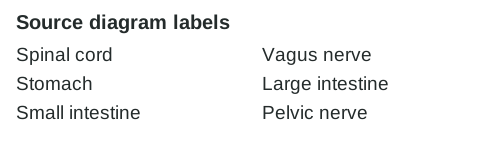
The vagus nerve, as we mentioned earlier, descends lower into the abdominal cavity, where the enteric nervous system of the gastrointestinal tract is located. It is called the “second brain” because it really is in many ways similar to the brain: it can work autonomously and even influence human behavior by sending signals to the brain through the vagus nerve. At the same time, both the brain and the “abdominal” brain contain auxiliary glial cells (they provide conditions for the transmission and generation of nerve impulses). At the same time, the brain contains 85 million neurons, and the “second brain” contains as many as 500 million neurons! Both produce equal (!) amounts of dopamine (one of the important parts of the brain’s “reward system”), since this hormone induces feelings of satisfaction and affects the processes of motivation and learning. And, most interestingly, the “second brain” in the abdominal cavity produces as much as 95% of serotonin – the “hormone of happiness”, while the brain produces only 5%!
I hope, it is now clear why any compression in the abdominal cavity or in any part of the vagus nerve passage can cause symptoms of hypochondria that simply cannot be cured by a psychologist. Moreover, antidepressants are often prescribed to such “patients”, while in order to develop natural “hormones of happiness”, it is only necessary to decompress the abdominal organs by biomechanically straightening the spine, and thus eliminating distortions of the entire body structure. It seems incredible that all these changes can be achieved only by adjusting the position of the jaw and the skull. But in this way, thanks to Starecta + mewing and craniodontics, thousands of people around the world have already received relief from the hypochondria that torments them and many of it’s accompanying symptoms. The mainstream scientific medicine is still “creaking” and resisting change, but is already beginning to lose ground under the onslaught of more and more startling discoveries in this area. And it really gives hope.
_________________________


2 comments
Ask a careful question or add useful context. New comments are reviewed before publication.
Thank you for this wonderful blog, I am learning soooo much. You are really saving lives!
Just one thing I didn’t quite comprehend: Can we see Starecta + mewing as a substitute for craniodontics?
Kind regards
Robin
As for the treatment – yes, Starecta + mewing can replace craniodontics if you don’t have severe crowding teeth!
You can find related notes in this archive.
You can also look this about combining of two methods as well as success story of my reader:
Starecta and mewing: how to reconcile conflicting forces (available later)
Sincerely hope it will help! ☀️