
A very good article by the founder of the Starecta spine-straightening method, Moreno Conte, on avoiding the negative consequences of manual therapy. I myself was directly harmed by such treatment when, unaware of the influence of proper jaw position on the spine, I suffered compression of the vertebral artery in my neck and changes in my body's posture after a manual therapist's rough intervention. This information helped me understand what had happened and why. I hope it will help you avoid fateful mistakes.
If you are one of those people trying to correct their posture, you will surely encounter manual therapists' websites showing their amazing results. The first thing you should know is that a manual therapist cannot straighten your spine completely. In fact, under manual intervention the spine never stretches upwards. Unless your spine is sufficiently stretched, you will never achieve proper posture, and manual therapy will lead only to dangerous muscular compensation that compresses organs, nerves and arteries, causing irreversible damage in the body.
Nevertheless, the purpose of this article is not tedious instruction but to give you tools that will help you feel independent and capable of understanding whether your posture has genuinely been corrected.
People imitating bad posture
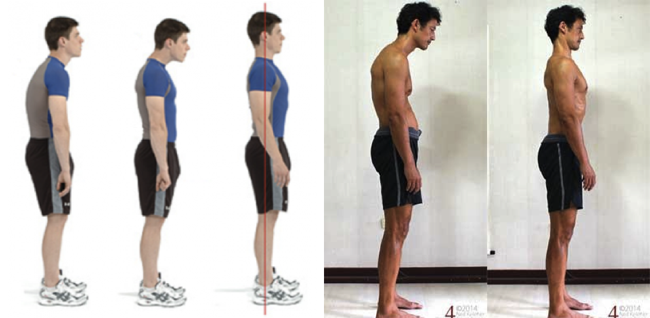
To begin with, I will talk about healthy people with straight spines, whom nature has given this gift: they make no effort to stand upright. You have probably already noticed that some of them imitate good posture for informational and educational purposes. An example of such a photograph is shown above.
The question that immediately comes to an intelligent person with a genuinely crooked spine after seeing these photos is: they must be joking? How can a structurally and biomechanically healthy person imitate hyperkyphosis and hyperlordosis? Why do experts ask healthy people to model bad posture? What is the point? This decision rests on the following fundamental misconception: these experts believe posture depends on the postural position. In their opinion, it can have only a psychological or neurological origin.
I would simply like to tell these postural experts that this incorrect posture is not rooted in the mind or the autonomic nervous system. A common mistake made by everyone working with posture is to focus only on the muscles, mind and nervous system. The enormous mistake of manual therapists in particular is that they try to solve crooked-posture problems simply by acting on the soft parts of the body: muscles and tendons.
The discovery of the Starecta method is that good posture originates in the bony structure bearing the body's weight (the rigid structure, not the soft muscular and tendinous one). Starecta's second major discovery is that a healthy bony structure finds its support in the biomechanism at the base of the skull and our dental system. For more information, please read the article on scientific proof of the bite's influence on posture.
This is demonstrated by the fact that trying to hold your head upright will not be enough to straighten you. Effort of will cannot improve your posture. People who can do this are already straight. They manage to hold their head upright because their skull is supported from below by the correct position of the jaw!
It is true: if you do not have hyperlordosis and hyperkyphosis, you will find it difficult to imitate them. But if you do have them, that is already a problem. Your problem, at that! Experts have not the slightest idea what it means to be crooked, with excessively curved lines of the back. They have no idea what it is like to be a stooped child with a forward head and shoulder blades sticking out like wings. They have no idea how much the skull really weighs and cannot even imagine the effort needed to try to hold it upright. They have absolutely no idea what it is to have real cervical and lumbar lordosis and thoracic kyphosis.
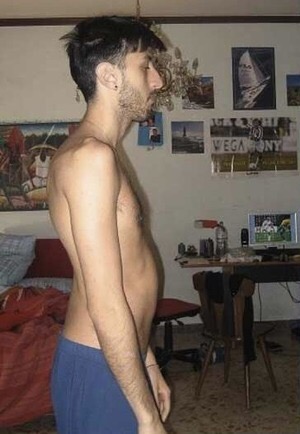
Unfortunately, I personally experienced all these sensations, and I would not wish them on anyone. In fact, I even wanted to leave this world. What I know and teach, I did not read in books: I discovered it through my own experience. By contrast, people who imitate false postures did not spend their youth in bed.
In fact, when a healthy person tries to imitate these bad postures, you can see it instantly. You can immediately notice that their physiological curves show no real change in terms of correct or incorrect posture. Their spine maintains the physiological harmony of its curves, with the proper length and in the proper space, even when they try to imitate kyphosis. To make this clearer, their spine is not subjected to any pressure from above due to a forward-positioned skull.
As I have repeated many times in the book “How I Straightened My Spine,” bad posture is caused by a lack of vertical space at the back of the jaw in the molar region, which causes non-physiological spinal curves. To avoid a forward head, the Starecta method uses the intraoral Rectifier device, which works in the mouth as a lever, recreating this missing space and straightening the spine by stretching it.
How to expose a false posture in a photo
1) The lower back
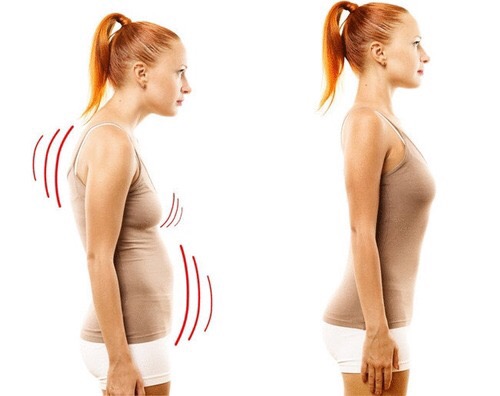
When a person with a straight spine tries to imitate a head lowered forwards and forward shoulders, the results are rather disappointing, because their lumbar curve is not accentuated at all. In fact, the opposite effect occurs: the lumbar curve moves in the opposite direction. Conversely, in someone who truly has lumbar lordosis, the lumbar region and back will not stretch.
2) The cervical area
When a healthy, upright person imitates bad posture, this does not change the structural position of their neck area. Their cervical curvature does not increase, unlike that of people who genuinely have this problem.
3) The thoracic region
People with straight spines who imitate hyperkyphosis have no hump in the thoracic area, which is typical of people with crooked spines. In upright people, the rib cage can expand and contract freely. It is not blocked by the spasming muscles around it. Moreover, their shoulder blades do not have the shape of wings turned upwards.
Experts trying to correct people's posture through fake successes
Online you can find many photos demonstrating fake postural changes presented as successes, although they actually represent nothing but the complete failure of manual intervention in these cases. In fact, patients who initially had ordinary postural problems have ended up with well-disguised severe postural problems. Although these results seem acceptable, they actually conceal effects that are very dangerous to the body.
The worst thing is muscular compensation. It is caused by manual manipulations intended to strengthen muscles in one area and weaken them in another. Thus, the spine does not straighten naturally; spasming muscles push it in the opposite direction. The patient then starts developing dangerous muscular asymmetry. This means asymmetrical muscles will compress organs, nerves and arteries and disrupt the body's normal functioning.
Fake case no. 1
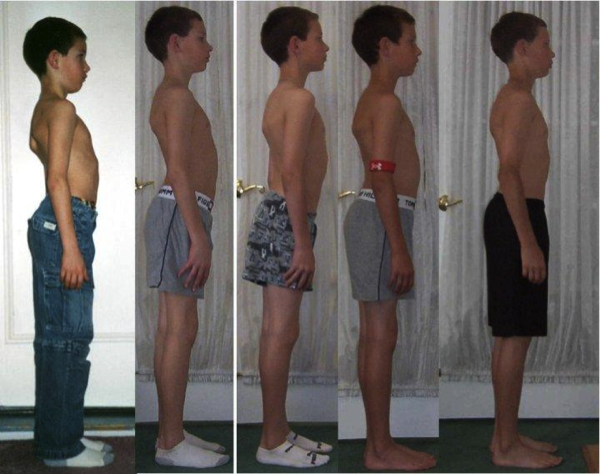
Let us take a case of lumbar hyperlordosis, for example. In this case, cervical lordosis must increase through muscular compensation, because the skull must try in every possible way to return backwards to the vertical axis passing through the body's center of gravity.
The muscular compensation effect does more harm than good, because it raises the collarbones further and makes the surrounding muscles compress the shoulder blades more, increasing the body's overall state of tension. The first negative consequence created in this case will be breathing problems: breathing becomes high and unsatisfactory precisely because of pressure created by the muscles around the rib cage: the trapezius, serratus posterior inferior, thoracic rhomboid, sternocleidomastoid, levator scapulae and so on.
In a state of muscular compensation, the thoracic area takes on a curved shape and forms the so-called hump (or thoracic kyphosis). With this unnatural, forced alteration of the spine, the space between the vertebrae in the lower back will decrease over time. To return the skull to an upright position, the manual therapist delegates all this work to muscles which, in their tense state, prevent the body from returning to natural well-being.
Paradoxically, the child in the first photo on the left, before manual therapy, has better posture than in the last one. In fact, the body position in the first photo is what the body developed for the lowest energy consumption and more or less normal well-being. In the photo before manual therapy, the skull is in an area intersecting the vertical line through the body's center of gravity. His cervical curve is definitely better than after treatment, and the child's shoulder blades, although winged, can move freely and do not create tension in the upper rib cage as in the last photo. The enormous lumbar lordosis, which improved so much in the last image, was in fact fictitiously solved by creating compensation in the back and neck muscles. Yet no scientific expert will tell you that the boy has no significant improvement.
Fake case no. 2
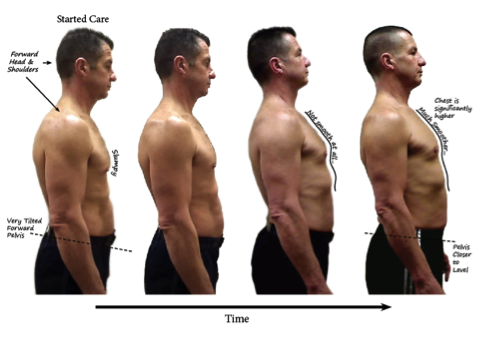
For an example, let us take another hyperlordosis case. Here, the initial situation was not very serious: the lumbar and cervical hyperlordosis is not excessive and is close to a physiological state, the shoulders are only slightly forwards, and the rib cage is only slightly sunken, creating just a little kyphosis in this area.
Overall, not such a bad initial condition. But manual intervention caused muscular compensation in the lumbar region, giving the person a practically awkward posture. In the last image on the right, you can see that by the end of treatment the patient is even bent backwards. This means the muscles, under the manual therapist's manipulations, were contracted so much that they started pulling the front of the body. This result is not only aesthetically ridiculous but actually caused dangerous compression of organs and internal structures.
Let us examine this case in more detail. In the sequence of photographs, you can see how the manual therapist created muscular compensations in the patient. For example, in the second photograph from the left, it is easy to see that useless and harmful work was done to shorten some muscular chains at the back: the latissimus dorsi, trapezius, rhomboid major and shoulder rotator cuffs. This compensatory work caused two effects. First, whereas before treatment the patient's head was lowered, in the second photo his gaze is horizontal. The problem is that this muscular compensation aggravated lumbar lordosis and thoracic kyphosis. From the manual therapist's viewpoint, a horizontally directed gaze alone is a sign of good posture. In reality, it is a sign of profound ignorance.
In the third image from the left, the manual therapist tried to correct the thoracic kyphosis that appeared after the first cycle of sessions. To do this, he tried to bring the shoulders back, especially the area of the rotator cuff and rhomboid muscle.
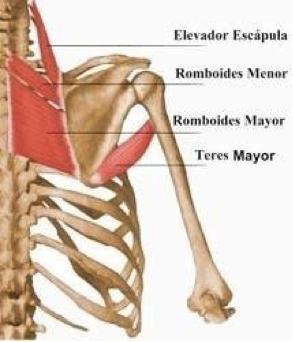
Instead, he only aggravated the existing problems. Lumbar lordosis also increased, and the upward-directed gaze is a classic posture in people lacking enough vertical space between the upper and lower posterior teeth at the back of the jaw.
Finally, the last photograph shows the result as a shortening of the muscular chains at the back of the body. Anyone looking at this photo will feel as though the person is hanging from a hook. This patient very likely really is suffering, because the vertebrae in this position are compressed to the extreme.
Fake case no. 3
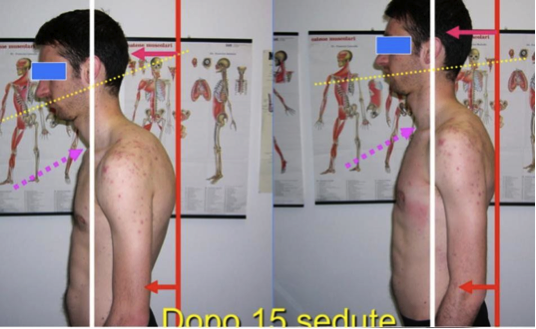
Let us consider a patient with severe thoracic kyphosis, lumbar and cervical lordosis, and a head lowered forwards. As we can see, after 15 manual therapy sessions his posture changed considerably. It seems that the patient's head has returned to the proper upright position relative to the body's central axis, but at what cost?
Let us look at what lies behind this trivial magic trick. This man, unlike the previous two, did not undergo serious manipulations, so he was fortunate enough not to develop serious muscular compensations. In short, his muscles were not brought to a level of extreme tension. But why, then, does his posture seem to have changed so radically? It is simple: in the photo, the patient is trying with all his might to stand straight. He is making enormous efforts to imitate an acceptable posture. Most likely, he has even unintentionally held his breath to maintain this body position. This happens when you do certain postural exercises whose effect is limited in time.
You can see this in the patient's shoulders, which are excessively tense and directed upwards (in the previous image, you can clearly see that his shoulders are relaxed). These are compensated muscles frozen in an artificial posture. I have no idea why he is fighting so hard for the treatment result. There may be several reasons: perhaps the therapist asked him to stand straight; self-suggestion; or localized intervention may have caused temporary muscular contraction. But his posture is so unnatural that we are certain that a few days after the photo, he returned to the position he was in in the before photo.
How the Starecta method differs

Even an untrained eye can see the difference between results obtained through simple, rigid muscular compensation and the results of the Starecta method. Unlike the manual therapy results we examined earlier, you can see that with my method the spine really stretched while the body's muscles were relaxed. The muscles are not in tense spasms to force the body to stand upright. The key to proper posture in the Starecta method is stretching the spine.
Thanks to the intraoral Rectifier device, the spine literally unfolds, because it finally finds the necessary space and stretches upwards. In fact, the skull with its displaced center of gravity no longer forces the spine to compress. With the Rectifier, it returns to the correct upright position and naturally stretches the spine. The result is obvious, and we will not tire of repeating how important this factor is and how radically it differs from the muscular compensation method. Moreover, during treatment the Rectifier eliminates all muscular compensations, because all the body's muscles start working symmetrically at normal lengths, both their own and those of their antagonists.
Conversely, with muscular compensation, patients become not only aesthetically unattractive and awkward but, because of differing muscle lengths and contractions, will probably suffer malfunctions in internal organs compressed by muscles as a result of manual manipulations, postural exercises and bone displacement.
In fact, our posture depends on the postural biomechanism in our dental system. The Starecta method's Rectifier straightens your body very naturally and simply, even if you are merely sitting on a chair. All other methods require enormous amounts of energy: silly exercises and dangerous manipulations are a waste of money and time, with zero results.
The Starecta Rectifier splint: which approach to choose — here.
Dystonia: an experience of biomechanical treatment — here.
___________________
The original article is on starecta.com. Russian translation


No comments
Ask a careful question or add useful context. New comments are reviewed before publication.
No comments yet. You can start the discussion.