
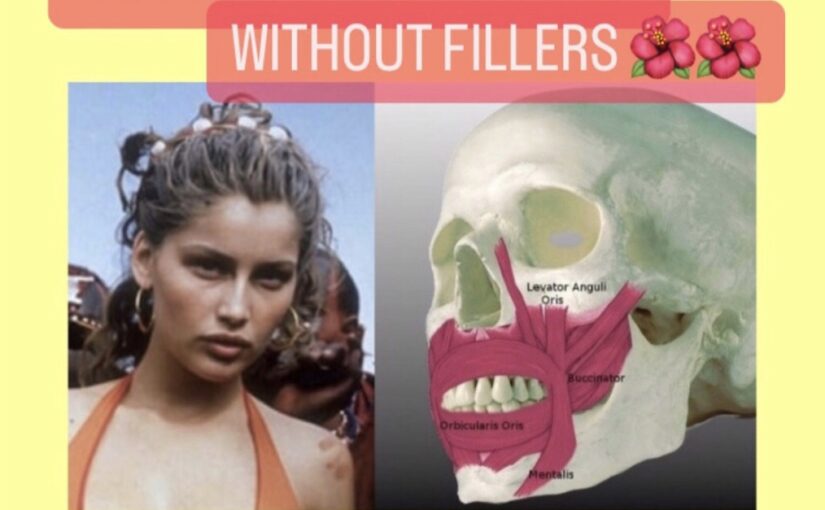
We were taught that the shape of our lips is genetically determined, inherited from our parents, and that there is nothing we can do about it. An entire medical and cosmetic industry is built on this belief. Yet many people forget that the lips consist almost entirely of muscle tissue, and soft tissues fit the underlying bone structure like a canvas fits a frame. In this article, let us explore how this ‘frame’ can be influenced to obtain fuller, more attractive lips.
For example, look at the shape of the lips of the lovely Laetitia Casta – she did nothing with them. The beauty’s lips have shrunk – only because the bones of her face have been gradually pushed inward over the years!⚡️
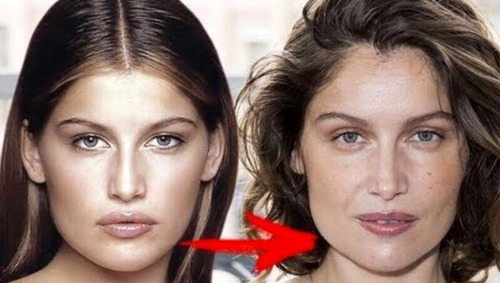
However, this process is reversible. Moreover, by working with the position of the facial bones, you can improve the shape of the lips at a young age!
Lip shape and the upper jaw
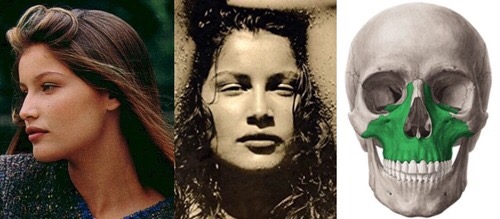
It is no secret that malocclusion and dental abnormalities alter the surrounding soft tissues: if the whole dental arch or individual teeth are displaced inward, the lips will also sink inward in those places, losing a considerable part of their volume. Malocclusion can also cause the corners of the mouth to drop, giving the face a sorrowful expression. Braces might seem able to correct this, but the situation is not so simple. We will return to braces; for now, let us take a broader view rather than looking directly into the mouth at the teeth, as most orthodontists do.
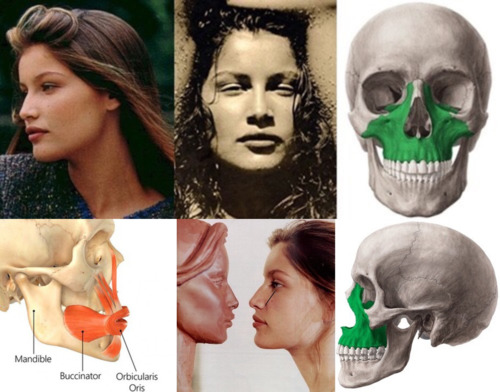
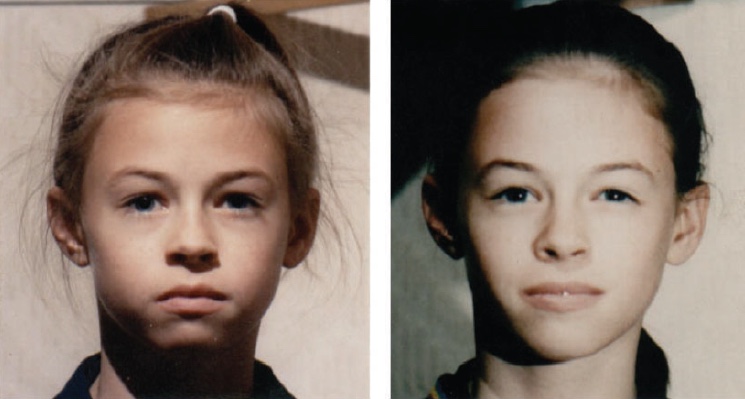
The teeth are situated on the upper jaw, the maxilla, with which this blog’s readers are already familiar. This paired bone extends quite deeply into the skull, forming the whole midface up to the eye sockets. If a person develops the habit of proper tongue position in childhood, with the tongue pressed firmly against the palate, its constant pressure on the maxilla pushes it forward and upward. The face then develops horizontally, leaving a relatively short distance between the nose and upper lip, while the upper lip itself is attractively pushed forward and upward. Compare the horizontally developed maxilla of the beautiful French model Laetitia Casta at the beginning of her career in the 1990s with that of a girl whose vertically developed maxilla is lowered and set back. Notice the difference between the two women in the distance from nose to upper lip and in the position and shape of the upper lip.
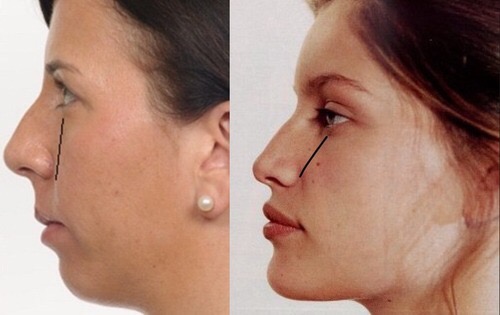
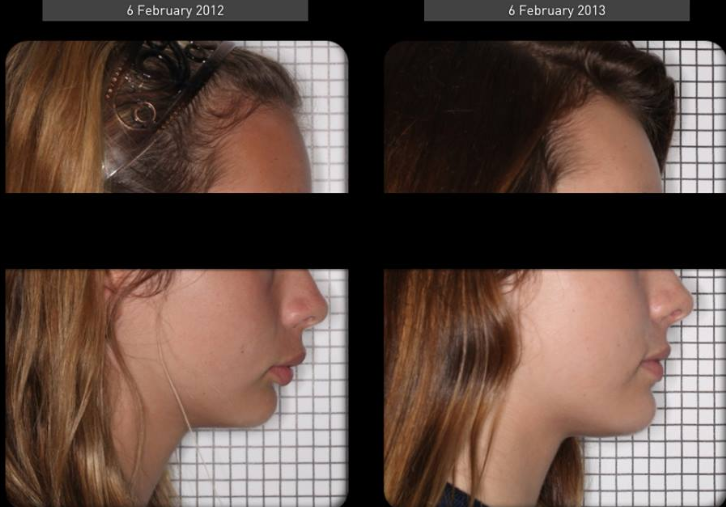
The girl in the photo on the left had four premolars removed⚡️ The removal of healthy teeth and the subsequent tightening of spaces with braces during orthodontic treatment can have a devastating impact on the shape of the face and lips!⚡️
Age, the maxilla and the lips
But what happened to the legendary model herself twenty years later—why did her bite and lip shape change so much? The delightful Laetitia Casta was once recognised as a standard of beauty; in 1999 she was even chosen as the model for the bust of Marianne that stands in town halls all over France, as Brigitte Bardot and Catherine Deneuve had been before her. The answer is simple: although the model’s maxilla was exceptionally wide, much wider than the norm, it apparently did not receive enough support from the tongue’s pressure against the palate even in her youth. In the first photograph, we see a beautiful, broad upper row of teeth, formed by the paired maxillary bones projected forward and upward, but the teeth already tended to crowd slightly inward. This is what happens when the maxilla does not receive enough tongue support from within. The situation worsens with age; twenty years later, Laetitia’s upper dental arch is much narrower, leaving insufficient space for all the teeth and resulting in noticeable crowding.
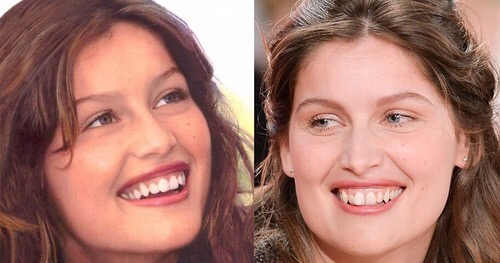
Because of insufficient tongue pressure, the model’s maxilla itself descended noticeably, significantly lengthening the midface. Comparing photographs taken twenty years apart with those from the beginning of her career, you can see how much the face descended and the distance between the nose and upper lip increased. The lips became much less prominent, even though their size remained the same.
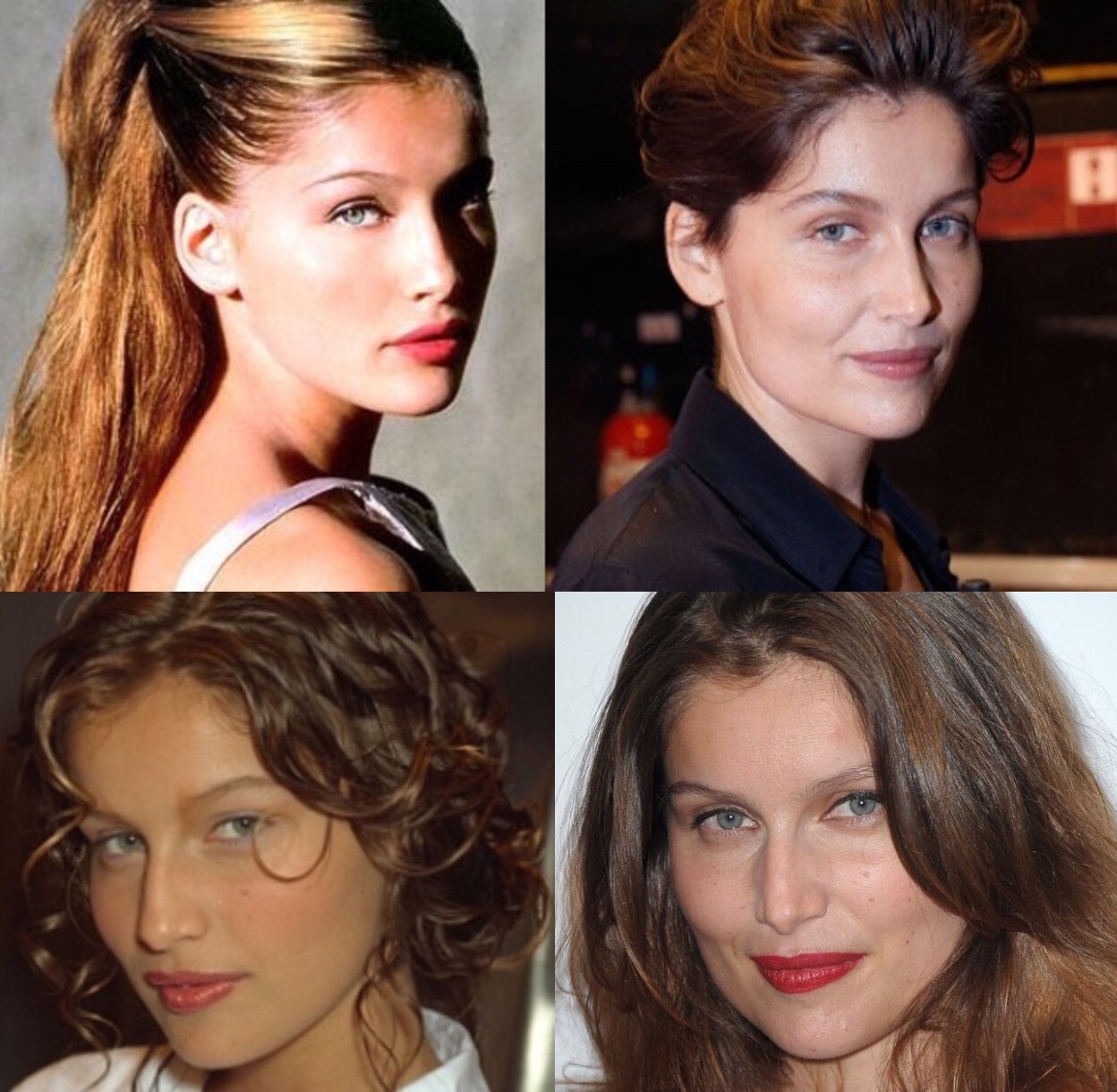
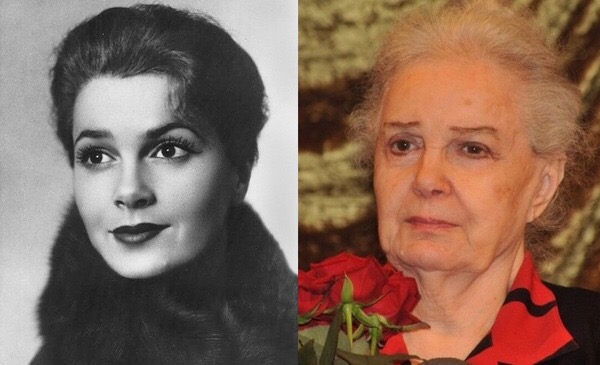
As we can see, when the maxilla descends, lips of the same volume literally sink inward too. Many people consider facial descent and a reduction in lip size with age inevitable, yet this really happens ‘merely’ because the maxilla lacks sufficient support from the tongue pressing against the palate. Consider another celebrity example: Elina Bystritskaya, one of the great beauties of the Soviet era, remembered from the film ‘And Quiet Flows the Don’. Her lips were not particularly large, but in her youth their attractive prominence was maintained by a sufficiently forward-positioned maxilla. In one of her latest photographs, the central face is visibly elongated downward, and an increased space has appeared between the nose and the upper lip. Although their volume is unchanged, the lips look sunken.
Another example is the handsome Konstantin Khabensky as he looked twenty years earlier. His many female admirers across the former Soviet Union admired his undeniably sensual lips; the picture we see now is dispiriting. His face used to be more horizontally developed, but in the latest photograph the descended maxilla has noticeably elongated it downward, and the lips have lost their former attractive prominence despite retaining their volume.

How to return the maxilla and lips to their position
1. Orthotropics
If, through playful myofunctional exercises, a child becomes accustomed to holding the tongue correctly from an early age, they will never have bite problems or need to see an orthodontist: the maxilla advanced in this way will ensure a broad dental arch and enough room for all the adult-sized teeth. It will also allow an expressive, prominent lip shape. This habit will help preserve the attractiveness of the midface and lower face even in adulthood and slow facial descent, thanks to horizontal development and a short, forward-positioned maxilla that keeps the space between nose and upper lip short.
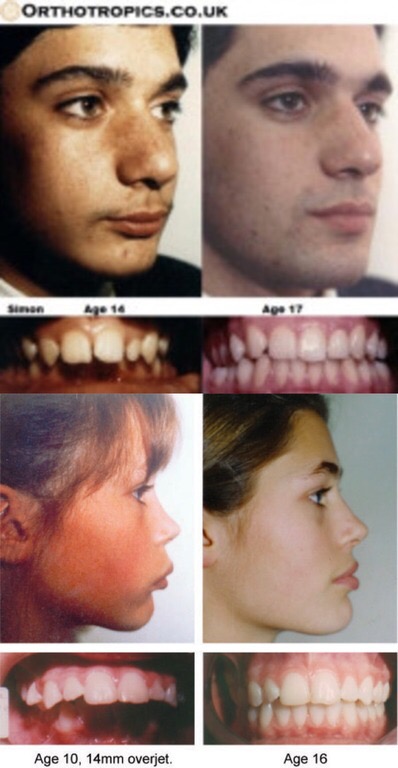
British orthodontist John Mew, the founder of the orthotropics approach to horizontal facial development, is convinced that lip shape depends on function and habit. Since the lips are mostly muscle, we can influence their shape and even their size to a considerable degree. He believes changing this in adulthood is not easy, because it takes more effort than in childhood, but is possible. One simply needs to develop the habit of holding the tongue correctly against the palate. This is the essence of myofunctional correction in orthotropics. Notice the changes in the patients’ lip shape and position before and after myofunctional exercises.
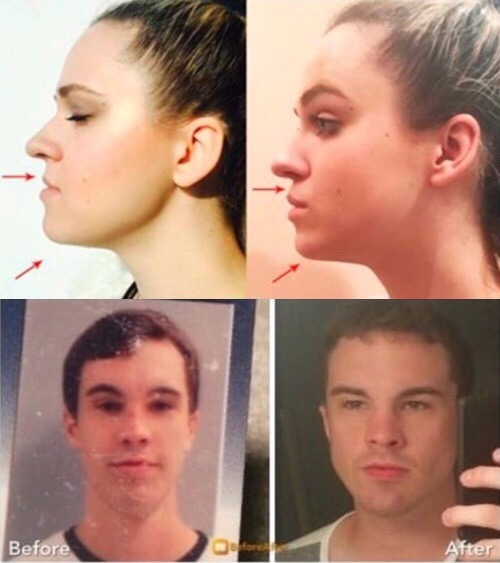
At the same time, in some particularly difficult cases, orthotropics also uses the intraoral Biobloc appliance to expand the upper jaw and sometimes the lower jaw. The results of the two patients shown were obtained without surgery or braces, solely through Biobloc and myofunctional exercises. Notice the forward horizontal movement of the maxilla, the changes in mouth shape and the direction of the corners of the lips, and the attractive prominence of the lips obtained in this way.
2. Orthocraniodontics
More widespread in our country than orthotropics, orthocraniodontics uses the lightweight-wire intraoral ALF appliance, together with craniosacral osteopathic techniques, to expand the upper jaw and address cranial deformations. The patients’ photographs show the midface rising, the distance between nose and upper lip decreasing, the mouth becoming wider and the lips more prominent.


3. Myobrace
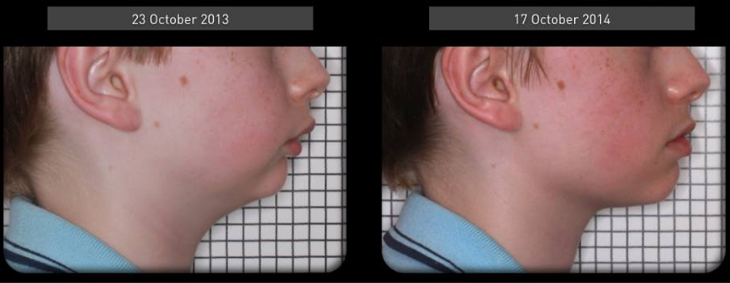
This trainer expands the dental arches and helps correct the bite and jaw positions, thereby changing lip shape and position. It should be worn for at least two hours a day, and preferably during sleep. The trainer is unsuitable for people with nasal-breathing problems. According to reports, wearing it is also rather uncomfortable. Notice the reduction in the distance between nose and upper lip in the photographs. The changes in lip position and shape speak for themselves: the result is impressive.
Lips and braces
Now let us look at what happens to the lips with braces. Aligning and straightening teeth might be expected to make the lips fuller, and this does happen in many cases. Unfortunately, many people find the opposite: the midface lengthens and the mouth becomes narrower. We have already discussed why, with illustrations, in the article on how braces change the face. Briefly, because of its particular mechanics, a braces system pulls the maxilla downward and narrows it, often causing irreparable harm to facial beauty and lip shape. The most negative effects on the lips occur when ‘unnecessary’ teeth are removed during treatment with braces. The young man in the photograph below had four premolars removed from the upper and lower dental arches. In the first photograph, we can see how elongated his maxilla is, how narrow the mouth became, and how his lips sank inward despite their fullness.
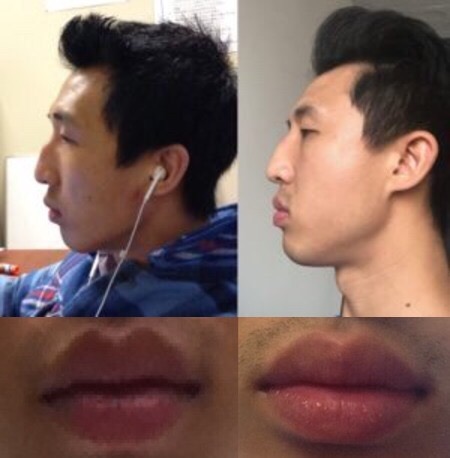
Seeking a way out of this situation, the young man turned to orthotropics. The second photograph shows the result obtained with Biobloc appliances fitted to both his upper and lower jaws, expanding the maxilla and creating room for the canines in both arches. He also actively practised myofunctional exercises to advance the upper jaw. Comparing the photographs before and after treatment shows an enormous difference in lip shape and position: with the same volume, his lips became much more prominent and attractive. Also notice how much the distance between nose and upper lip decreased in his case.

And here is how the volume of the lips changes when working only with the bones of the face, when the maxilla moves forward and up! Below you can see the changes of a guy (20 y.o.) in 1 year of mewing + intraoral face pulling. With the same size, his lips became much more prominent and voluminous!

(and by the way, moving his maxilla forward made his cheeks more hollow and his cheekbones higher) The guy is aspiring to become a model – now he has a much higher chance of achieving his dream!☀️
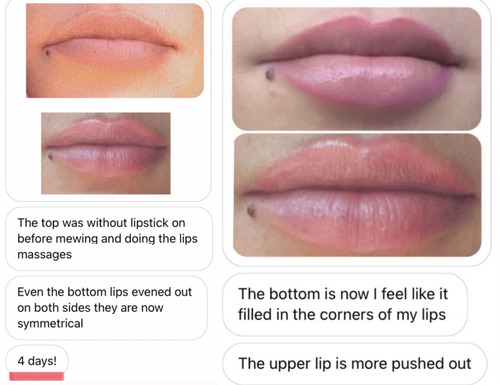
This message was sent to us by an extremely beautiful Latin American lady (41 y.o.) after just a few days of mewing and lip massage:
Many of you know very well our Colombian beauty Julie (25 y.o.) and may recall her feedback about the change in the shape of her lips ❤️ (1 year of mewing + intraoral face pulling):

I distinctly remember this review sent to us by an Asian girl after 7 months of mewing + intraoral face pulling. Stunningly beautiful lips!

Interestingly, when the lower jaw moves forward, the lower and upper lip become aligned! We recently received such an amazing review from this girl’s mom!
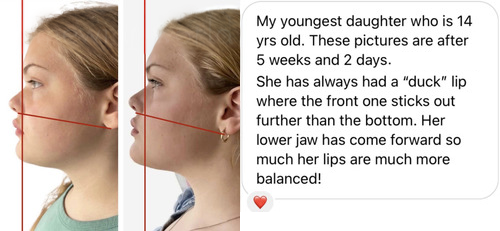
As all these examples show, our lip shape is not genetically predetermined: by changing the bite—or, more precisely, the position of the maxilla—we can influence its shape and even its size. And prominent, slightly ‘capricious’ lips are an attractive feature, particularly for women.
As you can see, soft tissues always follow changes at the bone level! I know that many of you would like to have fuller lips, and I understand this desire for beauty. I hope my observations will help you achieve your goal in the most natural way possible! ❤️ ______________________


No comments
Ask a careful question or add useful context. New comments are reviewed before publication.
No comments yet. You can start the discussion.